We use cookies to make your experience better. To comply with the new e-Privacy directive, we need to ask for your consent to set the cookies. Learn more.
ANSI Vs OSHA: Compliance for Warehouse Managers
November 25, 2025
|
Categories: Blog
To run an efficient warehouse, you need to run a safe warehouse. That means paying close attention to compliance — and that’s where things can get slightly complicated.
Regulatory standards often overlap. And in some cases, they reference one another; a private standard becomes the de facto legal standard. For warehouse managers, it can be tough to know where voluntary conformance ends and regulatory compliance begins.
That’s especially true when discussing OSHA (the Occupational Safety and Health Administration) and ANSI (American National Standards Institute) standards. Both play a critical role in workplace safety, but they function in very different ways. Understanding the difference between OSHA and ANSI is essential for maintaining a safe, compliant, and efficient operation.
If you’re looking for a quick answer, here’s what you need to know: OSHA makes the legally enforceable rules, while ANSI writes "how-to" guides for business compliance. OSHA is a federal government agency, while ANSI is a private, non-profit organization.
An ANSI recommendation can become a legal requirement, however. In this article, we’ll explain the roles of both organizations, how they work together, and what warehouse managers need to do to ensure compliance.
If you’re handling outfitting a warehouse, distribution center, construction site, or any other business, we’re here to help. Contact Solus Group at 314.696.0200 to find custom ergonomic material handling equipment for your operation.
OSHA Vs. ANSI: A Quick Overview
OSHA is the government agency responsible for ensuring safe and healthful working conditions for employees by setting and enforcing standards.
- Who they are: A regulatory agency of the U.S. Department of Labor.
- What they do: Create and enforce legally binding regulations, known as standards.
- Why it matters: OSHA compliance is mandatory. If an inspector finds a violation of an OSHA standard, it can result in significant fines and legal penalties.
For warehouse managers, OSHA standards cover everything from the structural integrity of walking-working surfaces and forklift traffic control to the requirements for signage.
OSHA also has a "catch-all" rule called the General Duty Clause, which requires employers to provide a workplace "free from recognized hazards.” That clause allows OSHA to cite employers for a hazard even if no specific standard exists for it—which is often where ANSI standards come into play.
What Is ANSI, and Why Is It Important?
ANSI is a private, non-profit organization that oversees the development of voluntary consensus standards for a vast array of products, services, processes, and systems in the United States.
- Who they are: A private, non-profit standards organization.
- What they do: ANSI doesn't write standards itself. It accredits standards-developing organizations and provides a framework for creating fair, consensus-based standards.
- Why it matters: By themselves, ANSI standards are voluntary. They represent industry-wide "best practices" and expert consensus on the safest or most effective way to do something.
You'll see ANSI standards referenced for everything from the color and format of safety signage (ANSI Z535) to the specific performance of an emergency eyewash station (ANSI/ISEA Z358.1). ANSI standards aren’t free — while the organization is non-profit, it’s not federally funded.
When Do ANSI Standards Become OSHA Requirements?
The line between OSHA vs. ANSI isn’t always obvious. Voluntary guidelines can become compulsory in two ways: through incorporation by reference and via the General Duty clause.
ANSI Incorporation by Reference
Sometimes, an OSHA regulation (or interpretation letter) will explicitly reference ANSI. This is an incorporation by reference. OSHA is legally adopting the ANSI standard, even though ANSI doesn’t have the legal power to establish a regulation.
As an example, let’s take a look at OSHA’s regulation for emergency eyewash stations:
The OSHA Rule: 29 CFR 1910.151(c) is a simple rule: Wherever employees are exposed to corrosive materials, employers must provide "suitable facilities for quick drenching or flushing of the eyes and body.”
The ANSI Standard: OSHA’s rule doesn't define suitable. For that, OSHA defers to ANSI/ISEA Z358.1. As we cover in our guide on emergency eyewash stations, the ANSI provides critical details for what “suitable" actually means: The station must provide a 15-minute flush, the fluid must be "tepid" (60-100°F), the flow must activate in one second or less, and so on.
ANSI Incorporation Via the General Duty Clause
Earlier, we mentioned that the General Duty Clause requires employers to protect workers from "recognized hazards.” But how does OSHA determine if a hazard is recognized?
If there’s an industry-standard mitigation for a certain hazard, that’s a clear indication that the hazard requires attention. And if a worker is injured by a hazard for which an ANSI standard exists, OSHA can argue that:
- The hazard was recognized, since a major standards-developing body (ANSI) had published a solution for it.
- The employer failed to protect the worker by not implementing the well-known solution.
- The employer violated the General Duty Clause.
In this context, ignoring a relevant ANSI standard is a significant legal liability, even if it's not explicitly incorporated by reference.
As an example, let’s consider a potentially serious hazard: A forklift damages a vertical upright on a section of pallet racking. It's bent, but still standing.
The OSHA Rule: OSHA does not have a specific, detailed standard that says, "A rack upright with a deflection of X inches must be replaced." The closest rule, 1910.176(b), simply states that materials must be stored securely and not create a hazard.
The ANSI Standard: ANSI MH16.1 ("Specification for the Design, Testing and Utilization of Industrial Steel Storage Racks") does have specific rules. It provides detailed guidance on how to inspect racks, identify damage, and the proper procedures for repairing or replacing damaged components.
If that damaged rack later collapses and injures a worker, an OSHA inspector may cite the employer under the General Duty Clause. Their reasoning will be that ANSI MH16.1 is a well-known, accepted industry standard, making "damaged pallet racking" a "recognized hazard." By not following the ANSI standard's inspection and repair guidelines, the employer failed in their general duty to keep the workplace free from this hazard.
Improve Compliance with Equipment from Solus Group
Don’t think in terms of ANSI vs. OSHA standards. There’s no “versus" here, since the organizations have a common goal (namely, to create safer workplaces).
The best practice is to view OSHA as setting the legal minimum and ANSI as providing the detailed blueprint for meeting and exceeding that minimum.
The most effective way to ensure safety and compliance is to use equipment that is explicitly designed to meet both standards. At Solus Group, we provide a wide range of MHE designed to go above and beyond regulatory requirements.
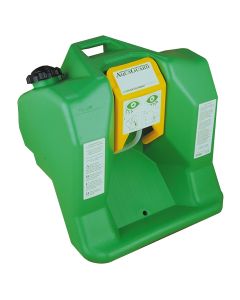
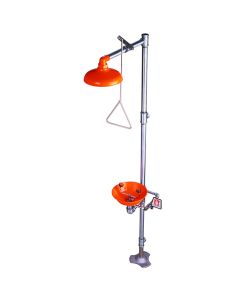
- Emergency Eyewash Stations: Solus Group’s emergency eyewash and shower equipment is built for ANSI/ISEA Z358.1 compliance — and designed to meet your facility’s operational needs. From Portable Eye Wash (PEW-700) stations to fully plumbed Shower Wash Eye Stations, all units meet relevant ANSI specifications.
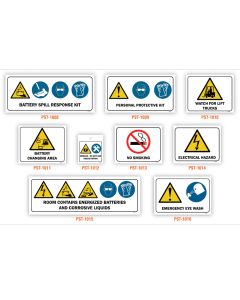
- Signage and Posting Kits: Clear, compliant signage is a frontline defense against workplace accidents. For simple outfitting, Solus Group carries signage and posting kits that are designed to meet both OSHA and ANSI Z535 requirements.
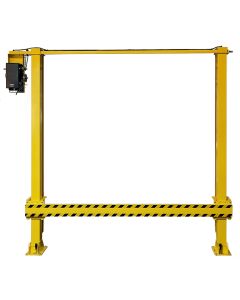
- Traffic Control and Safety: Solus Group's traffic control equipment is designed to enforce OSHA's pedestrian safety and fall protection rules while protecting valuable infrastructure from impacts. From high-visibility Structural Bollards to automated Powered Dock Gates, our solutions create safe, clearly defined zones for both people and equipment.
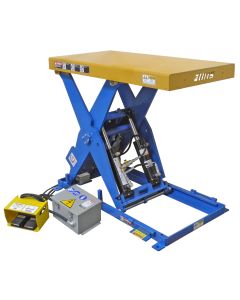
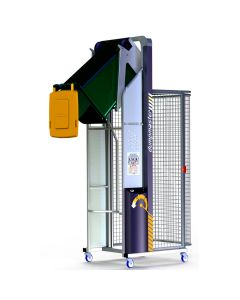
- Ergonomic Material Handling Equipment: Ergonomic injuries are a top source of citations under OSHA's General Duty Clause. For safer, more efficient workflows, Solus Group offers ergonomic material handling equipment. Our Lift Tables and Bin Dumpers are engineered to reduce physical strain, which helps to improve productivity and lower injury rates.
Ready to ensure your facility meets both OSHA and ANSI guidelines? Our team of experts can help you find the equipment for a safer, more productive operation.
Contact Solus Group at 314.696.0200 or to learn more.
Related Products
Dumpmaster® Hydraulic Bin Dumper
For pricing, contact us by calling 314-696-0200 or Request a Quote.
In stock