We use cookies to make your experience better. To comply with the new e-Privacy directive, we need to ask for your consent to set the cookies. Learn more.

Bin Dumpers Help Bring Composting to Campus at Kean University
July 14, 2026
|
Categories: Blog, Success Stories
Processing food waste is a messy job — and without the right equipment, it can be dangerous. Repetitive heavy lifting can cause musculoskeletal disorders (MSDs), and according to the U.S. Bureau of Labor Statistics, MSDs are responsible for 30 percent of occupational injuries.
That’s a significant issue, but it’s solvable: Investments in ergonomic material handling equipment (MHE) quickly pay off, particularly when that MHE is built into new processes for existing waste streams.
Founded in 1855, Kean University is a global institution of higher education located in Union, New Jersey. The university keeps a hopper and composting vessel inside their greenhouse to deal with the vast amount of food being produced on campus.
The Problem: Handling Campus Food Waste At Scale
Kean University’s President’s Sustainability Task Force seeks to create sustainability initiatives at the university while engaging the campus community. One of those initiatives: converting food waste into functional fertilizer.
To that end, food scraps are collected on campus, then mixed with kiln-dried wood shavings sourced from several local woodworking business. That mixture is aerobically digested through the composter to research the produced soil's ability to support plant growth for all landscaping projects, growing food and plants and strengthening soil health.
While planning the project, the task force recognized several potential issues:
- Depositing the food waste into the hopper created an ergonomic hazard. A fully-loaded 32-gallon trash bin can weigh more than 200 pounds.
- Manual material handling also introduced efficiency issues. Kean University recently achieved record-breaking enrollment — and given that surge in registrations, efficient waste handling is more important than ever.
- Any material handling equipment added to the initiative would need to be both purpose-built and affordable.
The Kean team decided to research MHE that could solve those problems. As part of that process, they reached out to Solus Group.
Related: Ergonomics in the Waste Handling Industry
The Solution: Bin Dumpers for Efficient, Ergonomic Waste Handling
Bin Dumpers are primarily designed to empty waste (though they have plenty of novel applications). Also known as bin tippers and trash can dumpers, they’re quickly becoming standard equipment at universities, hospitals, and commercial institutions of all sizes.
The Solus Group sales team considered various Bin Dumper models for Kean University’s application. Options like the Ezi-MT® Manual Bin Dumper and Multi-Tip® Hydraulic Bin Dumper are appropriate for smaller use cases, and the Ezi-MT® is particularly popular with custodial teams on high-traffic campuses.
However, Kean University’s composting initiative would require a unit with a much higher load capacity. The MHE would also need to lift high enough to empty into the hopper, and it would need to support a robust duty cycle.
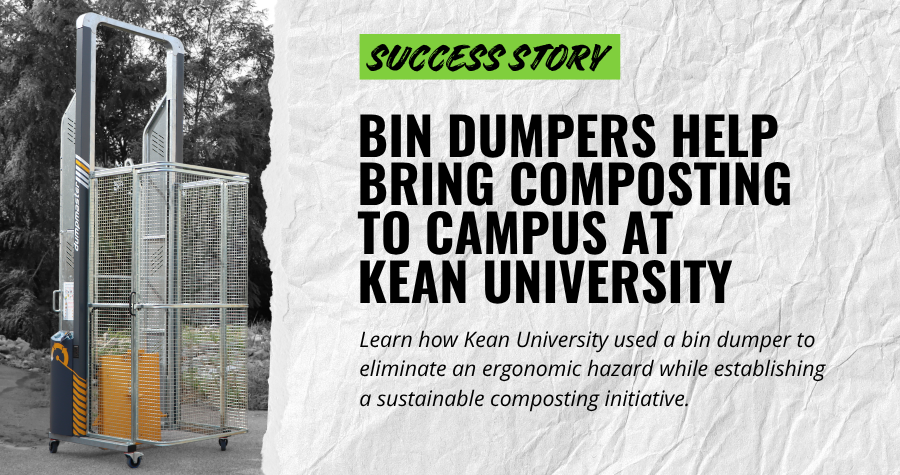
After collecting information about the project, Solus Group recommended the Dumpmaster® Hydraulic Bin Dumper. The Dumpmaster® had several features that aligned with the project’s goals:
- Capacity: The Dumpmaster® has a 550lb (250 kg) load capacity and suits popular bin sizes.
- Tipping Height: Standard tipping heights range from 27.5" to 106" (700 mm to 2700 mm), which was appropriate for the use case. The Dumpmaster® can also be customized to support heights of up to 246” (6000 mm).
- Power Flexibility: The unit has simple, weather-proof controls and multiple power source options.
- Mobility: Four casters allow the unit to be transported easily throughout any worksite (in this case, the greenhouse). The Dumpmaster® can also be locked in place with its two braked casters.
- Duty Cycle: With a duty cycle of 11,000 lb (5000 kg) per hour on continuous charge — or 22,000 lb (1000 kg) of material per charge, when battery-powered — the Dumpmaster® could handle the university’s food waste consistently at scale.
The Result: A Safer Approach to Composting Operations
By incorporating the Dumpmaster® into the existing composting setup, Kean University is working towards its long-term goal of providing a more sustainable campus — and giving something back to the farmers that feed their community.
Adding a Bin Dumper has improved efficiency significantly in the greenhouse while eliminating a major ergonomic hazard. The university also retroactively added the DumpMaster as a “potential inclusionary device” for future versions of this process, both to promote operator safety and increase production efficiency.
Several months after the purchase, the Solus Group sales team reached out to confirm that the DumpMaster was continuing to provide value for the Kean University composting operations.
“The Dumpmaster is working exactly as designed,” said William Heyniger, professor at Kean University’s School of Environmental and Sustainability Sciences. “It's a quality machine and has greatly assisted us in our composting operations. It’s awesome.”
Find the perfect material handling equipment for your operation. Describe your project for a free quote or call (314) 696-0200.
Related Products
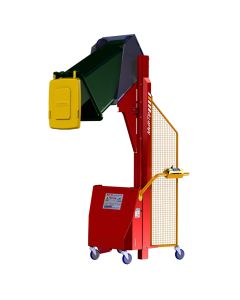
Multi-Tip® Hydraulic Bin Dumper
For pricing, contact us by calling 314-696-0200 or Request a Quote.
In stock
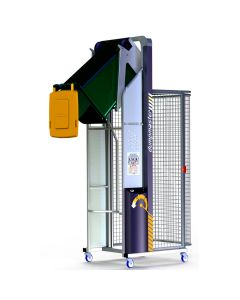
Dumpmaster® Hydraulic Bin Dumper
For pricing, contact us by calling 314-696-0200 or Request a Quote.
In stock
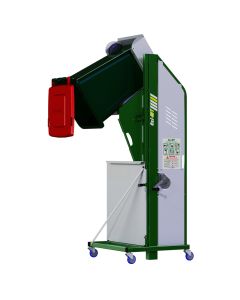
Ezi-MT® Manual Bin Dumper
For pricing, contact us by calling 314-696-0200 or Request a Quote.
In stock