We use cookies to make your experience better. To comply with the new e-Privacy directive, we need to ask for your consent to set the cookies. Learn more.
Case Study: Solus Group Bin Dumpers Help to Restore Hawaiian Reefs
May 26, 2026
|
Categories: Blog, Success Stories
Hawaii’s breathtaking coral reefs are a tourist attraction, but they’re also functional: According to the U.S. Geological Survey, reefs in Hawaii provide flood protection benefits to more than 6,800 people, averting $836 million in damages per year. Each 1-meter loss in reef height may increase the state’s floodplain by 33 square kilometers.
And while Hawaii’s live coral population is legally well protected, the reefs are currently in a state of gradual decline due to ocean acidification. Innovative technologies are needed to save Hawaii’s natural environment for future generations — and protect the homes and businesses currently on the island.
One environmental nonprofit had a plan to help Hawaii’s coral. The organization works with communities to protect and restore reef ecosystems by reducing land-to-sea pollution with green infrastructure.
Analysts at the nonprofit identified a weakness in Hawaiian waste streams: glass recycling. They reached out to Solus Group for material handling solutions that could help turn that weakness into opportunity.
The Problem: Poor Commercial Infrastructure for Glass Recycling
For decades, Hawaii has had issues with glass sustainability. That’s not due to a lack of effort: Hawaiian culture prioritizes environmental custodianship, and when given the opportunity, the state’s residents heavily participate in community recycling programs. In fact, the Aloha State has set a goal to reduce, reuse, or recycle 70% of its waste by 2030, and they’re well on their way to achieving that goal.
But standard glass recycling processes have failed to take hold in the Hawaiian islands. Over a decade ago, Maui halted its commercial glass recycling due to issues with operational logistics — and end-use issues, which prevented the recycled glass from providing much value to Hawaiians.
Currently, most glass is sent for mainland processing. The environmental nonprofit recognized the potential for change. Bottles could be converted into crushed glass, which could be used for aerobic treatment media and incorporated into vegetated leach fields.
The resulting product can help communities build filtration systems to eliminate cesspools — required by 2050 for compliance with Maui’s Act 125 — and help to create more sustainable water sources for swimming, surfing, and drinking.
But to fix the glass recycling problem, the nonprofit would need appropriate equipment:
- Pulverizer equipment to safely crush and smooth the glass; and
- Material handling equipment (MHE) to lift and dump the glass into the pulverizer.
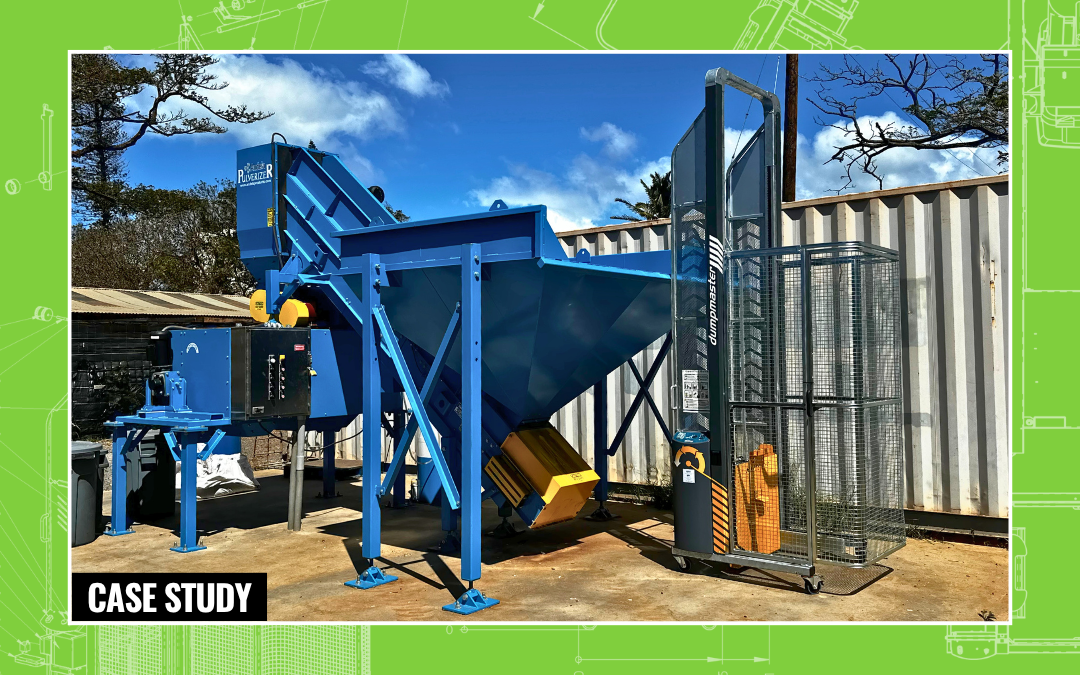
The organization’s team identified Mandela Mega-Mini Glass Pulverizer as a suitable solution for crushing the recyclables into sand. However, they still required ergonomic MHE that could dump the glass into the pulverizer efficiently, and without endangering operators. They contacted Solus Group to discuss options.
The Solution: A Specialized Hydraulic Bin Dumper for Recycling Operations
Solus Group partners with Simpro to provide a line of Bin Dumpers, which serve a wide variety of use cases. If materials need to be lifted to a set angle and then dumped out, Bin Dumpers are the answer — but specialized applications often require some degree of customization.
To meet the objectives of this project, Solus Group collected detailed information including:
- The type of bin being dumped;
- The approximate weight of an average load;
- The intended duty cycle;
- The dimensions of the cradle, which feeds materials into the pulverizer;
- The intended tipping height.
The Solus Group team also considered environmental factors (such as the salty tropical air, which tends to degrade industrial equipment) and potential power sources. After collecting the necessary info, the Solus Group team identified MHE that would slot seamlessly into the project.
The Result: A Bin Dumper for Glass Recycling Operations
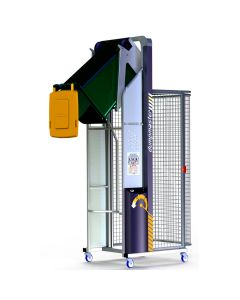
The Dumpmaster® Hydraulic Bin Dumper is ideally suited for this exact type of waste operation — specifically the DM2400, which features a 94.5" (2400mm) tip height and a capacity of 550 lb (250 kg).
The DM2400 had several features that contribute to the nonprofit’s mission:
- Power Source Flexibility - The Dumpmaster® can be outfitted with a battery powerpack, which provides operational versatility. The Dumpmaster® features a 24v/20Ah sealed GEL (3hr charge on 100-264VAC1-ph50/60Hz ≤ 3A) with the included industrial-quality 'float' charger.
- IP56 Rating - Ingress protection is vital in recycling and waste management applications. The Dumpmaster® features an IP56 rating, which can be upgraded if needed.
- Duty Cycles - With a typical duty cycle of 22,000 lb (1000 kg) of material per charge or 11,000 lb (5000 kg) per hour on continuous charge, the Dumpmaster® is powerful enough to keep recyclables moving.
In many situations, basic customizations are necessary to meet the needs of the use case; for this particular application, however, the Solus team determined that the standard DM2400 with a battery would provide an excellent return on investment.
Today, the green infrastructure organization is working to reduce glass exports throughout Hawaii and turn glass bottles into a high-quality, upcycled product. Their work helps to protect water sources — and create a more sustainable economy that will protect Hawaii’s coral reefs for generations.
Find the perfect material handling equipment for your operation. Describe your project for a free quote or call (314) 696-0200.
Related Products
Dumpmaster® Hydraulic Bin Dumper
For pricing, contact us by calling 314-696-0200 or Request a Quote.
In stock