We use cookies to make your experience better. To comply with the new e-Privacy directive, we need to ask for your consent to set the cookies. Learn more.
Tote Dumpers for Manufacturing: 4 Features to Look For
December 23, 2025
|
Categories: Blog
Material flow determines your operation’s productivity. The infeed stage is where bulk manufacturing materials are introduced, and it’s a point of vulnerability for many businesses.
Infeeding is mechanically simple: Pick up the materials and get them onto the product line. Or, to use simpler terms — dump them. But manual handling creates bottlenecks and introduces safety risks: A standard loaded Gaylord outweighs the NIOSH recommended maximum lifting limit (51 pounds) by a factor of 40.
Here’s where the right industrial material handling equipment (MHE) can play a big role. Tote tippers (like Bin Dumpers from Solus Group) are specialized container unloading machines that can automate the lifting and emptying of bulk containers, dramatically improving workplace efficiency on day one. To find the right Bin Dumper or tote tipper, you’ll need to match the equipment to your workflow.
Here’s (almost) everything you need to know when purchasing multi-purpose tote dumpers for manufacturing.
1. High Capacity and Container Compatibility
The most logical way to classify dumping equipment is by the type of container it handles, whether that is a single tote, a box, or a Gaylord. Your tote tipper needs to be matched to the task at hand.
Start by recording the unloaded weight and dimensions of your tote bins, Euro bins, trash cans, or whatever containers you use for bulk infeeding.
Then look for a tote dumper that matches those specifications. For heavy-industrial applications, look for robust steel construction. Tote dumpers should also have adjustable restraints capable of holding bins of varying dimensions. That ensures the equipment is versatile enough to handle different raw materials.
2. Mobility and Flexibility
Traditional, fixed material handling infrastructure can become a problem for manufacturers that embrace Lean or Agile principles. You may need to reconfigure product lines for changing demands — in which case you’ll need tote dumpers that can be moved or repositioned.
To future-proof your operation, prioritize mobility. A mobile dumper equipped with heavy-duty casters and dual floor brakes allows the unit to be deployed precisely where the infeed bottleneck occurs.
3. Operator Safety and Ergonomics
Automating infeed improves workplace safety with protections against musculoskeletal disorders (MSDs) caused by repetitive lifting. However, people still need to operate the equipment — and if the safety factors aren't all addressed, injuries can still occur.
Look for units with push-button operation, which allows for controlled dumping with the operator at a safe distance from the machine during the lifting and dumping cycle. The mechanism should be designed to keep the container’s center of gravity safely within the machine’s footprint throughout the entire dumping arc to prevent tipping.
4. Customization
In manufacturing, "standard" is a relative term. You may be working with a legacy hopper or belt conveyor with a specific dump height requirement. Your raw materials may be stored in non-standard drums. When off-the-shelf equipment cannot interface with your existing infrastructure, you need a provider capable of custom engineering.
Custom fabrication can quickly pay a return on investment. Essential customizations might include:
Modified cradles and chutes to accommodate unique container shapes or minimize material waste during the dump cycle.
- Specific tip heights and angles to ensure certain materials (such as granular ingredients) exit the container completely.
- Enclosures and guarding to meet specific facility safety protocols.
- Stainless steel construction or wash-down-ready components to meet FDA regulations for food and beverage or pharmaceutical environments.
Choosing a supplier with custom fabrication capabilities ensures that the equipment adapts to your facility.
Products from Solus Group
At Solus Group, we provide material handling solutions engineered to stand up to the demands of modern worksites. When equipment isn’t quite ready for the job at hand, we work with our partners to build solutions — including custom tote dumpers designed for the challenges of infeeding.
Options to consider:
BHS Mobile Gaylord Dumper (GLD)
The GLD is engineered for demanding, multi-stage applications, capable of elevating fully loaded Gaylords to a tip height of over 54 inches. It features a 2,000- or 4,000-pound capacity and an adjustable restraint bar for versatility, while heavy-duty casters allow it to move freely throughout a facility.
Simpro Dumpmaster® Hydraulic Bin Dumper (DM)
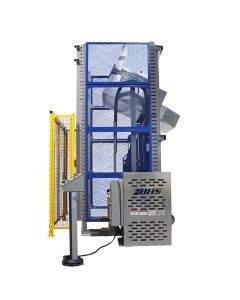
For heavier loads and stringent sanitation requirements, the Dumpmaster® gets the job done. It handles weights up to 660 pounds and is available in stainless steel, providing excellent throughput for food processing, pharmaceutical, and other manufacturing applications.
Simpro Multi-Tip® Hydraulic Bin Dumper (MT)
For operations handling standard totes and bins, the Multi-Tip® offers a unique lift-and-tip action that maintains stability by keeping weight within the machine's footprint. It’s ideal for loads up to 330 pounds and features a cradle compatible with most standard roll-out bins.
Forward Bin Tipper (FBT1000-760)
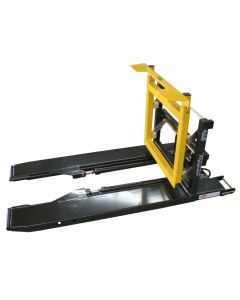
Turn your existing forklift fleet into a mobile dumping fleet. The Forward Bin Tipper attaches to standard forks to handle cubic bins, pallet bins, and megabins weighing up to 2,205 pounds, offering a flexible, cost-effective solution for facilities with diverse material handling needs.
Ready to outfit your operation with a tote tipper that improves safety and efficiency? Contact the Solus Group sales team at 314-696-0200 or send us a message online today.
Related Products
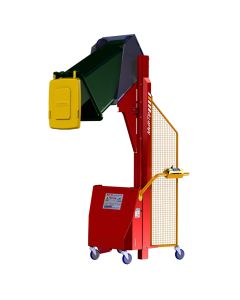
Multi-Tip® Hydraulic Bin Dumper
For pricing, contact us by calling 314-696-0200 or Request a Quote.
In stock
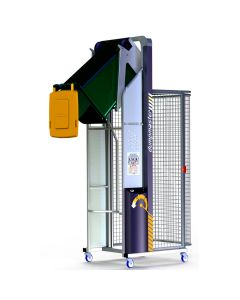
Dumpmaster® Hydraulic Bin Dumper
For pricing, contact us by calling 314-696-0200 or Request a Quote.
In stock