We use cookies to make your experience better. To comply with the new e-Privacy directive, we need to ask for your consent to set the cookies. Learn more.
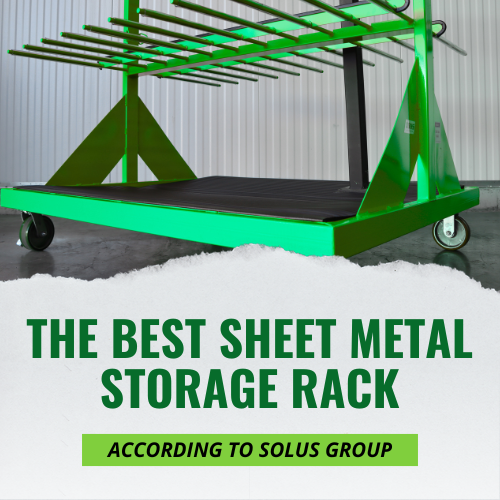
The Best Sheet Metal Storage Rack, According to Solus Group
March 17, 2026
|
Categories: Blog
In metal fabrication, efficiency is usually measured by the speed of the cut or the precision of the laser (or waterjet, or plasma table, as the case may be).
But a significant portion of operational downtime occurs long before the torch is lit. When machinery sits idle, the facility loses revenue — and in operations that regularly handle heavy plate and thin-gauge sheets, storage strategy is crucial.
Today, we’ll discuss the foundation of an efficient workflow: the sheet metal storage rack. At Solus Group, we believe that the best option for high-output operations is roll-out shelving designed for the task at hand. Here’s what to know when outfitting your facility.
Vertical vs. Horizontal Sheet Metal Storage
When selecting a sheet metal storage rack, the first decision is the orientation of the material. Both horizontal and vertical orientations can be functional, depending on your square footage and the frequency of your material changes.
Horizontal Sheet Storage (Flat-Stack Storage)
Horizontal (or pallet-style) sheet racks are frequently used for high-volume storage of uniform gauges:
- Pros: Flat-stack storage eliminates the risk of bowing or warping in thinner gauges by providing continuous support across the surface area of the sheet.
- Cons: By storing sheets horizontally, you sacrifice a degree of accessibility. To get to the bottom sheet in a stack, an operator must move every sheet above it, which makes your operation more reliant on forklifts. Repeatedly stacking and unstacking sheets can also mar the surfaces of some of the product.
Vertical Sheet Storage
Vertical racks store sheets on their long or short edges:
- Pros: A much smaller footprint and greatly improved accessibility. Horizontal storage requires a forklift; with vertical storage, you can expose the entire face of the sheet, enabling other options for material handling (such as suction cups, pneumatic grippers, and so on). An operator can pull sheets without damaging the rest of the inventory.
- The Disadvantage: Without proper support, thinner-gauge sheets can lean and bend under their own weight.
For a long time, horizontal storage was the de facto standard; if you’re moving materials with a forklift, it’s hard to imagine a functional alternative.
But the best rack is the one that solves the accessibility problem of horizontal storage while providing proper support. For high productivity, the roll-out shelf system provides the best of both worlds.
Related: Sheet Goods Material Handling: A Guide to Storage and Transport
How Roll-Out Shelving Systems Improve Efficiency
Whether you choose a horizontal or vertical orientation, a roll-out mechanism transforms a storage rack from a passive shelving unit into an active piece of material handling equipment. That improves material handling in several key ways:
100% Shelf Extension for Crane Access
Static racks require a forklift to enter the rack; otherwise, a worker must manually slide the sheets out. A high-quality sheet metal storage rack with roll-out shelving allows the shelf to extend fully into the aisle — opening the entire surface area of the metal to overhead bridge cranes, magnets, or vacuum lifters.
By eliminating the need to dig into a rack, you also reduce the risk of forklift tines striking the racking or scratching the surface of high-finish materials like stainless steel or aluminum. The racking itself is also protected from impact damage.
Space Optimization and Floor Density
Static horizontal racks require wide aisles to accommodate the turning radius of a forklift. Because roll-out shelves can be accessed via overhead cranes or narrow-aisle vacuum systems, you can reduce your storage footprint by up to 50%.
High-density storage allows you to keep a wider variety of gauges and alloys in the same square footage. It’s also an excellent way to reduce the travel time between the storage area and the machine bed.
Improved Ergonomics
Manually wrestling with a 4' x 8' sheet of 10-gauge steel is a high-risk activity. To understand the risk, we look to the National Institute for Occupational Safety and Health (NIOSH) and their revised lifting equation for ergonomic material handling.
In a static rack, a worker must reach into a bay to grip a sheet, which increases the horizontal distance from their spine. As horizontal distance increases, the Recommended Weight Limit (RWL) drops significantly.
Roll-out systems bring the material to the worker. That keeps the employee in the power zone — the area between the mid-thigh and mid-chest — and allows mechanical lifters to take 100% of the load.
In other words, a roll-out system shifts the worker from a manual mover to a machine operator, significantly reducing the risk of musculoskeletal disorders (MSDs). And since MSDs are responsible for about 30% of injuries resulting in days away from work, ergonomic improvements can provide a return on investment very quickly.
Related: OSHA Lifting Limits Demystified
Spotlight: The Vertical Sheet Rack System
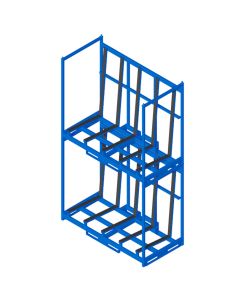
For high-mix, low-volume production, we recommend the BHS Vertical Sheet Rack System (VSRS). It’s a precision-engineered storage solution that utilizes a series of roll-out drawers nested within a compact, steel frame. Materials are stored vertically on their edges, which improves visibility and accessibility.
The VSRS is built for heavy-duty industrial use. Each drawer is capable of handling up to 2,000 pounds (907 kilograms). It supports sheet sizes up to 12' x 6', making it compatible with the vast majority of standard laser and waterjet beds.
Best For:
- High-Value Alloys: The individual bays of the VSRS prevent sheets from rubbing against one another. It’s a critical feature for expensive materials where a single scratch could mean a total loss.
- Remnant Management: Shops often lose money because drops and remnants get lost in the back of a flat stack. The VSRS keeps every piece of metal visible, allowing operators to identify and use remnants before cutting into a fresh sheet.
- Limited Footprint Shops: The vertical orientation scales your inventory upward rather than outward. That preserves floor space for additional machinery or assembly stations.
- Quick-Changeover Workflows: Because the drawers roll out smoothly on heavy-duty bearings, an operator can access a new gauge in seconds, reducing machine idle time between jobs.
Essential Sheet Material Racks from Solus Group
While the roll-out Vertical Sheet Rack is the premium solution, different workflows require different tools. Other options include:
Standard Sheet Material Racks
The BHS Sheet Material Rack (SMR-4896) provides an organized way to store flat materials vertically in a static location. Racks are equipped with removable side arms for stacking extra-long material and four-way fork pockets for convenient transport and positioning.
The rack includes a 12-gauge steel floor to protect the edges of your material from floor moisture and damage.
- Angled back and deck for safe storage.
- Anti-skid rubber surface helps to prevent material from sliding out.
- Four-way fork pockets.
- 8,000 lb (3629 kg) load capacity.
- 96" wide x 48" deep.
- Can be stacked up to three units; contact our sales team for more information and capacities.
Best For: Storing plywood, drywall, or large metal sheets in a fixed location where manual picking or light forklift assistance is the norm. It’s an excellent budget-friendly alternative for secondary materials.
Cantilever Racks
For lighter materials with non-standard dimensions, the BHS Cantilever Rack (CRA3K Series) offers an open-front design. BHS cantilever systems feature adjustable arms, allowing you to customize the vertical spacing as your inventory changes.
- Fork pockets enable transport by forklift when not in use
- Steel, powder-coated frame for enhanced durability
- Adjustable shelf height in 2” (50 mm) increments
- 5 sets of gravity-locking arms standard, with more available
- Removable shelf arms creates more usable height per shelf
- Carrying capacity of 250 lb (113 kg) per arm, 500 lb (227 kg) per shelf, and 3,000 lb (1361 kg) per rack.
Best For: Storing bar stock, tubing, and other materials that exceed standard lengths. It’s ideal for a wide variety of awkward materials, with exceptional flexibility and customizability.
Mobile Sheet Material Racks
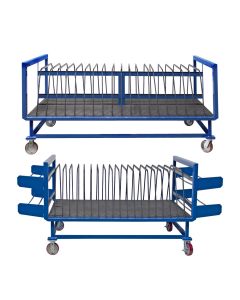
Mobile Sheet Material Racks (MSMR) turn your inventory into a mobile asset. The rack is designed with a sloped deck to ensure that sheets lean securely against the uprights during transport, preventing tip-overs in transit.
- Vertical storage and transportation for sheet materials.
- Suitable for use with a wide range of construction and manufacturing. goods, including glass, drywall, panels, plywood, stone, and metals.
- Rugged design withstands the rigors of construction sites and warehouses.
- Reduces material storage footprint to preserve square-footage.
- Prevents damage to sheet materials by removing the risk of falling or bending.
- Heavy-duty phenolic casters allow transportation for bulk sheet materials.
Best For: Job shops where material needs to move between a shear, a press brake, and a welding station. It eliminates the need for multiple forklift transfers, keeping the material at the point of use.
Vertical Material Racks (Static)
The Vertical Material Rack (VMR) is designed for long-term storage for pipes, bars, and lumber. The narrow footprint preserves floor space, while the four rows of steel retainer bars keep materials safe.
- Simplified storage and movement of bars, pipes, lumber, and other long, narrow materials.
- Ideal for material supply houses, construction projects, warehousing, and other applications that handle materials of many different lengths.
- Four rows of steel crossbars secure vertical goods at varying heights.
- Anti-skid rubber at the base prevents products from sliding.
- Heavy-duty casters allow for repositioning of supplies.
Best For: Storing pipes, bars, and lumber of varying lengths in a single unit. It is particularly effective for maintenance departments and small fabrication cells that need quick access to raw stock.
Find Sheet Metal Handling Solutions for Your Operation
Don't let your material handling be the bottleneck in your production. Investing in a roll-out system like the Vertical Sheet Rack System provides dividends in reduced injury rates, lower material scrap, and higher machine uptime.
Looking for a different solution? Send us a message online or call us at 314-696-0200 to discuss a custom storage configuration for your facility.
Related Products
Mobile Sheet Material Racks
For pricing, contact us by calling 314-696-0200 or Request a Quote.
In stock