We use cookies to make your experience better. To comply with the new e-Privacy directive, we need to ask for your consent to set the cookies. Learn more.

Sheet Goods Material Handling: A Guide to Storage and Transport
January 20, 2026
|
Categories: Blog
Musculoskeletal disorders account for approximately 30% of all workplace injuries involving days away from work, according to the Bureau of Labor Statistics. A significant portion of these injuries occurs during the manual handling of sheet goods — large, heavy panels of drywall, glass, and steel that lack natural grip points.
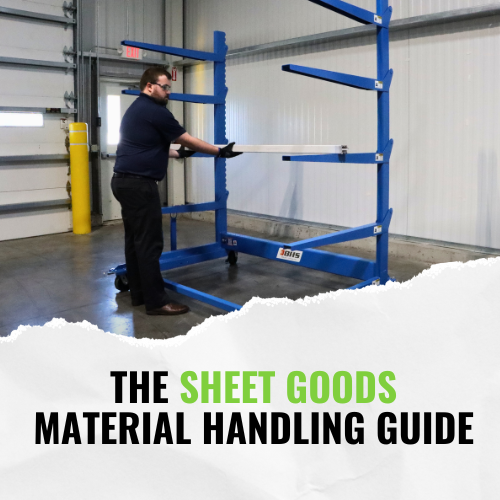
Because of their surface area and weight distribution, sheet goods present unique challenges for storage and transport. Improper handling doesn't just result in damaged product — though the cost of scratched stainless steel or cracked glass adds up quickly — it’s also a leading cause of workplace injury.
You cannot rely on makeshift solutions; you need an engineered approach to material handling. Whether you’re outfitting a manufacturing floor, a distribution warehouse, or a construction site, operational success depends on choosing the right storage systems and sheet goods carts.
In this guide, we’ll explore the best practices for storing and moving panel-shaped materials by comparing the features of vertical racks, roll-out systems, and specialized transport carts.
If you’re outfitting an operation, we’re here to help. Contact the Solus Group sales team at 314-696-0200 or send us a message online to discuss options.
The Logistics of Sheet Goods (And Why Specialization Matters)
Let’s take a moment to consider the physics involved in moving panels. Palletized loads are stable and uniform, but sheet goods are prone to tipping, warping, and sliding.
Consider the following:
- Center of Gravity - Carrying panels vertically keeps the center of gravity close to the body (or the cart frame), but requires balance. Carrying them horizontally requires immense floor space and lifting power.
- Surface Protection - Materials like glass and polished metal require contact surfaces that won't harm the finish.
- Weight Density - A stack of drywall behaves differently than a single slab of granite. Your equipment must be rated not just for the total weight, but for the distribution of that weight.
Standard forklifts and pallet jacks aren’t ideal for moving individual panels. To optimize your workflow, you must implement solutions designed specifically for the geometry of the sheet.
Optimizing Storage: Vertical vs. Cantilever Systems
Effective storage is about more than just maximizing floor space (though that’s certainly a factor). You need to think about accessibility and damage prevention, and vertical racking and cantilever-style systems can address these challenges in distinct ways.
Vertical Sheet Rack Systems vs. Fixed Racks
For high-density storage where floor space is at a premium, vertical storage is usually the better choice. Storing sheets upright (on their long edge) reduces the footprint significantly compared to flat stacking.
However, there is a distinction between fixed racks and roll-out systems:
Fixed Sheet Material Racks
These are the standard A-frame or bay-style racks found in many lumber yards and warehouses. They consist of vertical dividers that allow you to sort materials by SKU (e.g., separating 1/2" plywood from 3/4" plywood).
Best For: Quick manual access to lighter materials; retail environments; and manufacturing cells where operators grab single sheets by hand.
Vertical Sheet Rack Systems (Roll-Out)
For heavy industrial applications — particularly with sheet metal — a Vertical Sheet Rack System is an excellent investment. Drawers or racks that slide out from the main frame, allowing employees to handle sheets with sheet lifts, magnets, hoists, and other material handling systems.
Best For: Dense storage of heavy steel or stone; utilizing overhead cranes or hoists for picking; and protecting high-value surfaces from scratching during retrieval. The space-saving roll-out design dramatically improves storage while enabling a single user to access the product.
Cantilever Racks and Carts
Cantilever systems use horizontal arms extending from a vertical column. While often used for bar stock or lumber, they’re effective for sheet goods when laid flat.
Best For: Bulk storage of flexible materials that might warp if stood vertically for long periods (such as certain plastics. thin-gauge sheet metal, or thinner MDF), or for extremely long items that exceed the depth of standard vertical racks.
Handling and Transport: Moving Panels Safely
Once the material is off the rack, the challenge shifts to transport. Injuries become a serious concern here: The awkward leverage required to move a 100-pound sheet of drywall manually is a textbook ergonomic hazard. Vertical loads can also obscure an operator’s view, so loads should be pushed (not pulled) to keep the operator safe in case the load tips.
For a deeper understanding of safe lifting mechanics and preventing back injuries, refer to the CDC/NIOSH guide on Ergonomic Guidelines for Manual Material Handling.
To mitigate these risks, you need the right rolling stock.
Comparing Sheet Goods Carts with Hand Trucks and Dollies
A common mistake on job sites is attempting to move panels with a standard two-wheel hand truck or a flat furniture dolly. A standard hand truck offers no side support, forcing the operator to use their own strength to balance the load. A flat dolly offers no vertical support, requiring the operator to bend awkwardly to push the load while holding the sheets upright.
A dedicated sheet goods cart or panel cart solves this by incorporating a support frame. The cart carries the weight; the operator simply provides the motive force.
Panel Carts for Construction and Remodeling
Construction sites are challenging for material handling. Floors are uneven, debris is common, and spaces are tight.
A cart designed for a smooth warehouse floor will fail on a construction site. You need a panel cart equipped with large, heavy-duty casters that can roll over drywall screws, sawdust, and extension cords without seizing.
On remodeling jobs, you often need to move materials through standard 30-inch doorways. An A-frame or upright Panel Cart keeps the load vertical and narrow, allowing easy navigation through tight corridors and elevators.
Handling Mixed Materials with Adjustable Carts
In manufacturing and diverse warehousing, loads are rarely uniform. One trip might involve a bundle of conduit, the next a stack of plywood, and the next a variety of dimensional lumber.
The solution is an Adjustable Panel Cart with removable uprights or dividers. Users can reconfigure the cart on the fly — creating a wide bed for thick stacks of insulation, or narrow bays for separating different types of sheet metal. That flexibility prevents load shifting, where loose materials slide into one another during transport.
3 Material-Specific Considerations for Equipment Selection
When browsing Solus Group’s catalog for your sheet handling solution, consider the specific physical properties of your inventory:
- Glass and Finished Stone: Never use bare steel racks or carts for these materials. Look for equipment with padded surfaces, rubber-lined uprights, or wood-faced decks. Vibration during transport can shatter glass, so pneumatic or semi-pneumatic casters are often preferred to provide shock absorption.
- Sheet Metal: Steel sheets are dense and have sharp edges, so plastic carts aren’t an option. You’ll need all-steel, welded construction with high weight capacities. Powder-coating is essential to prevent the cart itself from rusting after being scratched by sharp metal edges.
- Drywall and Plywood: Here, the goal is to minimize sliding. Look for a slightly angled deck (a "lean-to" design) that uses gravity to keep the sheets pressed against the support frame.
Sheet Goods Material Handling Products from Solus Group
At Solus Group, we provide a curated selection of industrial-grade material handling equipment designed to withstand the rigors of heavy panel transport.
Vertical Sheet Rack System (VSRS)
Ideal for manufacturing and metalworking, the VSRS transforms sheet storage with a roll-out design. By allowing individual racks to extend 100% from the frame, it facilitates overhead crane access and increases storage density. It’s the ultimate solution for protecting high-value metal sheets while maximizing floor space.
Vertical Material Rack (VMR)
For facilities that require high-density, fixed storage, the VMR is a robust solution. Designed to hold sheet goods upright, it minimizes the storage footprint while allowing for easy organization of different SKUs.
Its heavy-duty steel construction can handle up to 3,000 pounds of wood, plastic, or metal. Two stock models match most storage requirements, and custom models are available on request.
Mobile Sheet Material Rack (MSMR)
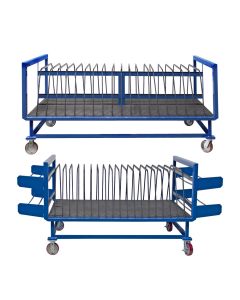
Heavy-duty phenolic casters allow Mobile Sheet Material Racks (MSMR) to transport bulk quantities of plywood, drywall, stone, and sheet metal directly to production lines. The vertical-storage design minimizes the overall footprint to preserve valuable floor space while preventing materials from falling, bending, or sliding.
Powder-coated steel crossbars hold materials securely within the frame during transit to eliminate stock losses and improve site organization. Available in one- or two-compartment models, these racks accommodate a wide range of goods, including glass and metal panels.
Panel Cart (PC)
The PC is a job site essential, built with a heavy-duty steel frame to transport drywall, plywood, and other sheet goods securely. Its simple, robust design ensures stability during movement, while its high weight capacity handles heavy loads with ease.
Designed to navigate the challenges of construction zones while keeping materials organized and accessible, the Panel Cart features removable handles, a durable powder-coat finish, and a carpeted plywood deck to protect product.
Adjustable Panel Cart (APC)
Adjustable Panel Carts (APC) utilize adjustable-position PVC dividers to provide flexible handling for multiple sizes, widths, and types of materials on a single cart. This vertical panel truck accommodates a wide variety of inventory — including plates, bars, pipe, and electrical panels — by allowing users to customize the gap between dividers.
PVC contact surfaces protect product during transit. Easy-steer poly casters improve ergonomics and mobility under heavy loads, ensuring smooth movement across industrial environments. The adaptable design provides a reliable solution for organizing and transporting uncommon loads safely.
Cantilever Cart (CCA)
When you need to move bar stock, lumber, or long, narrow panels, the CCA is the answer. It combines the storage logic of a cantilever rack with the mobility of a heavy-duty truck, allowing you to bring long, awkward materials directly to the point of use.
Shelf arms are 39 inches (991 millimeters) long, with a carrying capacity of 500 pounds (227 kilograms) per shelf for high-volume material handling — a total capacity of 2,500 pounds (1134 kilograms). Standard units feature four sets of gravity-locking arms, with more available on request.
Ready to outfit your operation?
Moving sheet goods doesn't have to be a gamble with employee safety or product integrity. By investing in purpose-built racks and carts, you streamline your workflow and reduce costly accidents.
For help selecting the right equipment for your specific materials — or to discuss custom configurations — contact the Solus Group sales team at 314-696-0200.
Related Products
Mobile Sheet Material Racks
For pricing, contact us by calling 314-696-0200 or Request a Quote.
In stock