We use cookies to make your experience better. To comply with the new e-Privacy directive, we need to ask for your consent to set the cookies. Learn more.

6 Types of Tugger Carts (and Which is Best for You)
July 15, 2025
|
Categories: Blog
If you’ve considered an investment in a tugger train system, it’s time to get rolling. Tuggers can move multiple wheeled carts in a single trip, optimizing material flow — and in many cases, improving worker safety by minimizing material handling tasks.
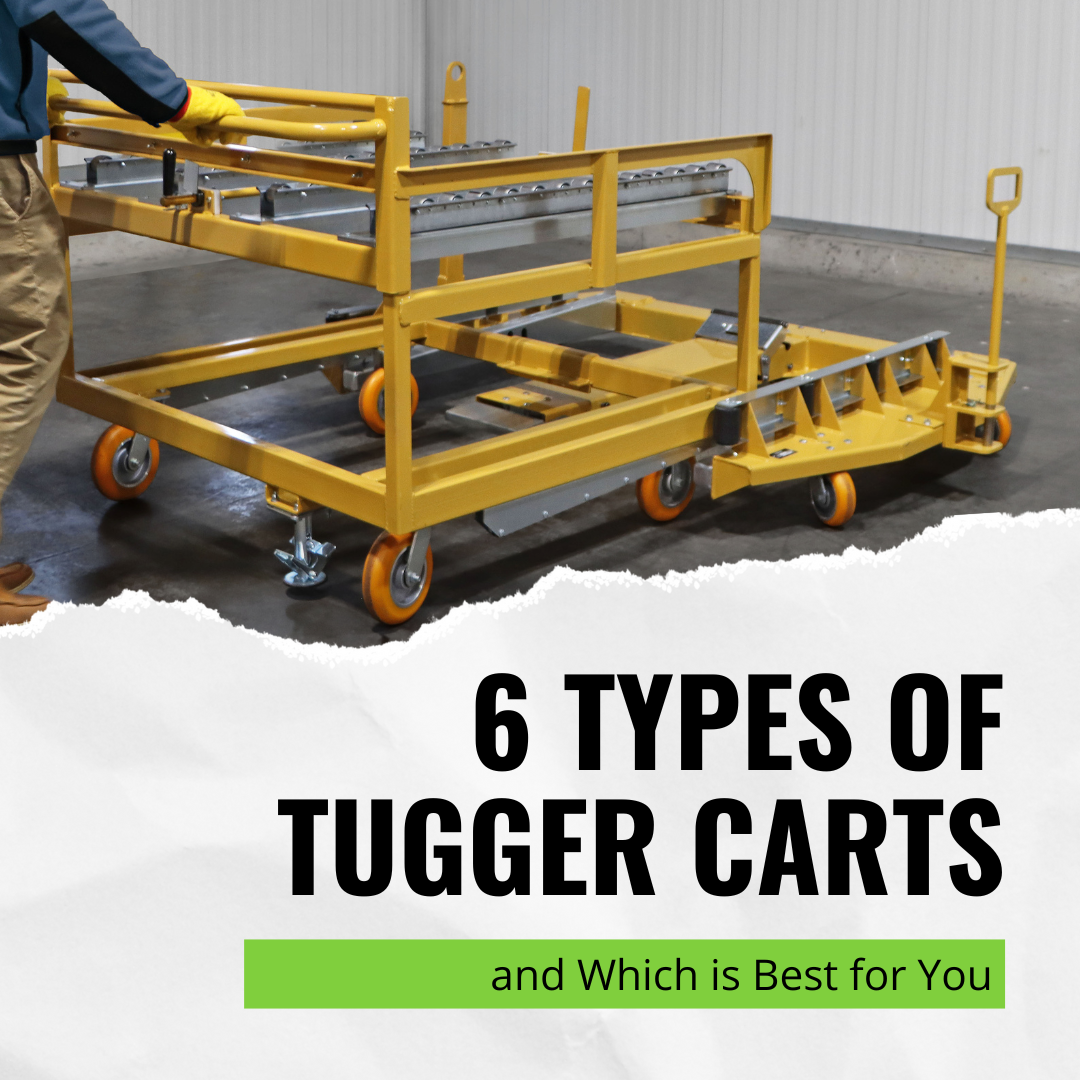
In other articles, we’ve discussed the differences between warehouse tugger carts and manual carts, and we’ve explained how modular carts can add flexibility to tugger train systems. Today, we’re breaking down the most common types of tugger carts and their applications.
The Three Categories of Tugger Cart Systems
There are three major categories of Tugger Carts: platform carts, shelved carts, and mother-daughter carts. Each can be outfitted with three basic steering arrangements: center-steer, quad-steer, and dual-steer (we’ll discuss those more in a moment).
By understanding the advantages of each of these options, you can build a Tugger Cart system that makes sense for your organization — and provides optimal productivity from the first day of service.
1. Platform Carts
Platform carts feature a simple, flat deck, which makes them the versatile backbone of many material handling fleets. The open design is ideal for transporting oversized or irregularly shaped items, palletized goods, or large containers.
Basic platform carts feature a high load-bearing capacity, and they’re easy to load and unload from any direction.
Primary Use Cases: Ideal for moving large, heavy, or palletized goods in bulk from one point to another, such as from a receiving dock to a production or storage area.
2. Shelved Carts
As the name implies, this is a platform cart equipped with one or more shelves. It’s ideal as a tool for organization and small-parts handling.
Shelves are essential for kitting, order picking, and lineside replenishment, where organized, easy access to multiple components is critical for workflow efficiency. Solus Group carries shelved carts that can be configured as fixed, adjustable, or angled to improve ergonomics and load retention.
Primary Use Cases: Best for organizing and transporting smaller items, facilitating order-picking tasks, and delivering kitted components to assembly lines.
3. Mother-Daughter Cart Systems
A Mother-Daughter System is an efficient solution for multi-stop delivery routes (or "milk runs"). This setup consists of a large "mother" frame that carries one or more smaller, removable "daughter" carts.
Operators can quickly exchange daughter carts at various workstations without decoupling the main train. By linking multiple platform or shelved carts — each designated for a specific stop or order — you can create a highly effective system for any milk run application.
Primary Use Cases: Used for high-efficiency, multi-stop delivery routes to distribute specific kits or collect materials from various workstations without dismantling the train.
The Three Steering Arrangements for Tugger Carts
A cart's steering mechanism determines its maneuverability and tracking fidelity when pulled by an electric tugger. Once again, there are three basic options:
1. Dual-Steer Carts
This common design features two swivel casters at the front and two rigid casters at the rear. Options like the Tugger Cart - Dual Steer (TT-DS) offer a superb balance of reliable tracking in a train and ergonomic control during manual positioning. They’re a cost-effective choice for general manufacturing and warehousing applications.
Primary Use Cases: A versatile option for general warehousing and manufacturing, offering tracking performance for trains along with maneuverability for manual use.
2. Quad-Steer Carts
Also known as all-wheel steering, Quad Steer Tugger Carts (TT-QS) offer precision and stability. In a quad-steer system, all four wheels articulate in unison. This allows a long train of Quad-Steer Carts to follow nearly the exact path of the tugger vehicle, minimizing "snaking" of the rear carts.
Primary Use Cases: The TT-QS is ideal for operations with narrow aisles, complex routes, and long trains where precise tracking is essential to prevent collisions.
3. Center-Steer Carts
This unique design uses two additional, centrally located wheels that allows the cart to pivot within its own footprint. This gives Center-Steer Cart (TT-CS) unmatched maneuverability for U-turns in dead-end aisles or navigating extremely congested work cells.
Primary Use Cases: Travel paths with sharp pivots and U-turns in dead-end aisles or tightly packed work cells.
Choosing the Right Tugger Carts for Your Operation
To be clear, you’ll need to plan carefully when incorporating a tugger train system into your workflow — and that means collecting info about how your operation currently works and how it would ideally function. That may differ in manufacturing plants compared to warehouse environments, or systems that use automated material handling equipment instead of manual labor, for example.
Regardless of the context, some factors to keep in mind when building industrial tugger systems include:
- Load Type and Size: Are you moving large, bulky items or smaller, organized components that would benefit from organization? Will loads change, or will they be consistent each month?
- Towing Vehicle: Will you use electric tow tractors, lift trucks, or other types of towing tractors? The answer may determine some specifications for trailers, including hitch systems and load capacity.
- Facility Layout: How wide are your aisles? Do your routes involve sharp, numerous turns (Quad-Steer) or dead ends that require pivots (Center-Steer)?
- Operational Flow: Do you primarily perform point-to-point bulk transfers, or do you run multi-stop milk runs that require precise tracking and delivery?
- Train Length: The longer your tugger train, the more you will benefit from the superior tracking and stability of Quad-Steer carts.
- Manual Interaction: Will operators need to frequently push, pull, or rotate carts by hand at workstations? If so, Center-Steer carts may offer ergonomic advantages.
If you’re ready to design a custom material handling flow for your facility, we’re here to help. Contact our sales team at 314-696-0200 to discuss your unique challenges and find the right solution.
Related Products