We use cookies to make your experience better. To comply with the new e-Privacy directive, we need to ask for your consent to set the cookies. Learn more.

A Guide to Warehouse Signs: What to Post for Workplace Safety
August 26, 2025
|
Categories: Blog
Warehouse safety signs are essential for accident prevention — and as such, missing signage is a common factor in OSHA (Occupational Safety and Health Administration) violations.
Essentially, if workers are exposed to a significant hazard in your warehouse environment, you need workplace signs to communicate that hazard. And while a missing or misplaced sign might not lead to an immediate fine, it’s a legal liability. More importantly, missing signs pose a threat to worker health and safety.
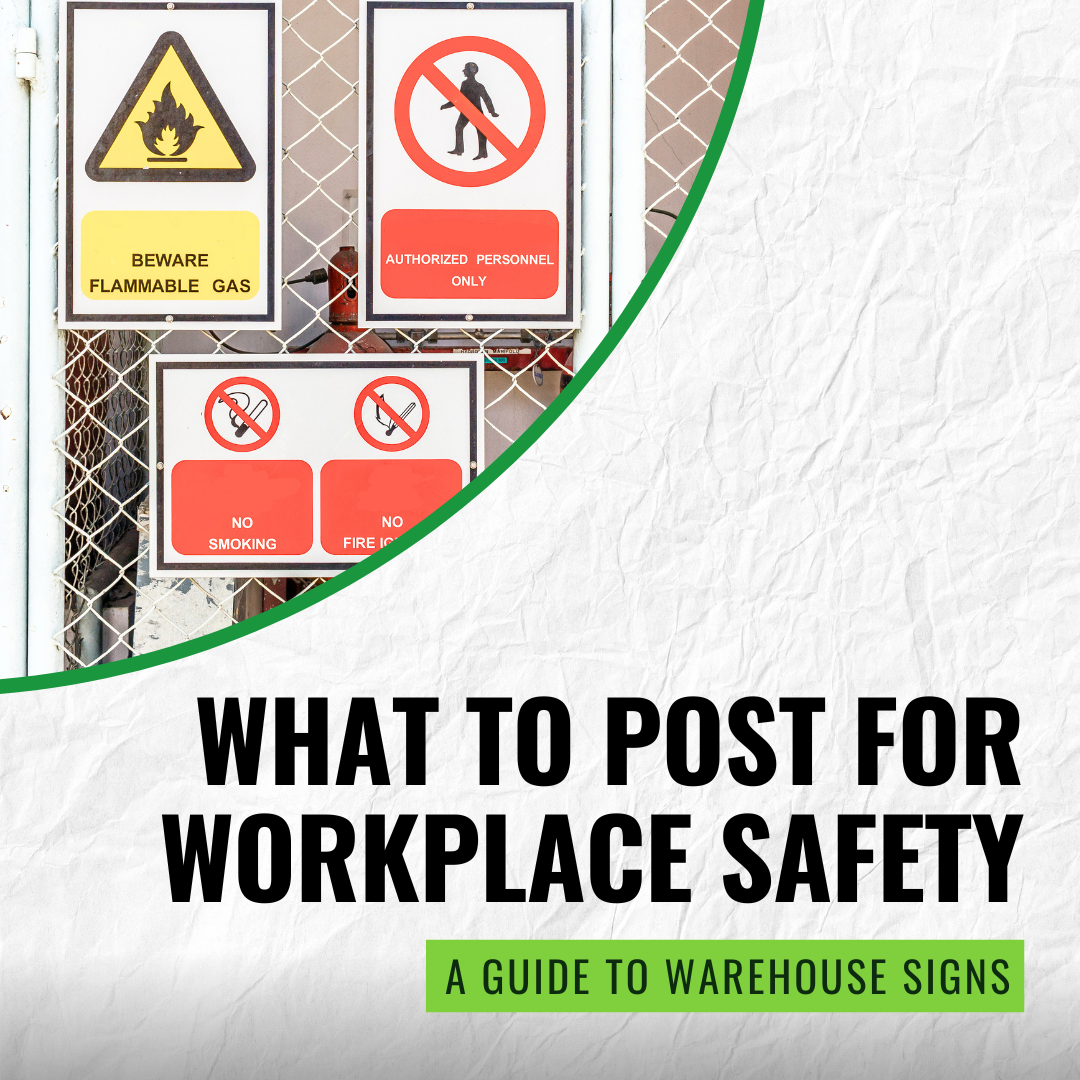
Solus Group carries OSHA- and ANSI-compliant signage to help employers meet their obligations (and keep costs down by limiting workplace accidents). In this article, we’ll explain the legal standards for signage in warehouses, distribution centers, and other industrial environments. We’ll also provide some tips for avoiding common mistakes when choosing and posting signage.
The Legal Minimum for Warehouse Signage: OSHA 29 CFR 1910.145
The foundational legal requirement for safety signage in general industry workplaces is OSHA standard 1910.145. That rule outlines three primary classifications of safety signs and signals, each with specific design and color requirements:
- Danger Signs: This is the highest level of hazard communication, reserved for situations where an immediate danger exists that will result in serious injury or death if not avoided. OSHA is unequivocal about these hazard warning signs; there can be no variation in the design, and employers are required to instruct all employees that danger signs signal an immediate and severe threat requiring special precautions. The color specifications are red for the upper panel, with black or white letters, and a white lower panel for additional information.
- Caution Signs: These warning signs are used to warn against potential hazards or to caution against unsafe practices. The hazard level is one where an accident could result in minor or moderate injury. The standard specifies a yellow background for the sign, with black letters. If a black panel is used for the signal word, the letters within it must be yellow.
- Safety Instruction Signs: These mandatory signs are used when there is a need for general instructions or suggestions related to safety measures. They are not for warning of a direct hazard, but they provide helpful information such as the location of safety equipment or reminders of safety policies. The standard color scheme is a white background with a green panel and white letters.
Beyond these classifications, OSHA mandates certain physical characteristics for all signs:
- They must be furnished with rounded or blunt corners and be free from sharp edges, burrs, or splinters.
- Any fastening devices like bolts or screws must be located so they do not create a hazard themselves.
- The wording on any sign must be concise, easy to read, and contain enough information to be clearly understood.
- The wording should make a “positive, rather than negative” suggestion.
OSHA 1910.145 goes into additional detail about biological hazard signs, general tag criteria, and more — but if you’re not in the practice of manufacturing signs, you probably don’t need to dig through all of the details.
Here’s what employers must know: Workplace signage must accurately reflect the level of danger caused by the hazard, and signs should be manufactured to meet OSHA/ANSI requirements.
What Does ANSI Require for Signage?
ANSI (American National Standards Institute) lays out standards for environmental and facility safety signs in ANSI Z535-2011 (R2017). That includes rules for safety headers, sign legends, colors, and so on.
In interpretation letters and in standard 1926.200, OSHA has recognized ANSI Z535-2011 as compliant with the more general standards of 1910.145. This means that if you’re purchasing ANSI-compliant signage, they’re OSHA-compliant, too (and vice-versa).
Some key differences between ANSI standards and OSHA regulations include:
- ANSI establishes “Warning" as a signal word, filling a critical gap between OSHA’s “Danger" and “Caution" warning levels.
- ANSI establishes the Safety Alert symbol, an equilateral triangle surrounding an exclamation point.
- The Z535 standards provide extremely detailed guidance for standardizing the format of signs and the pictograms displayed on signs.
Once again, you don’t need to know every single ANSI standard when purchasing — you simply need to be aware that the standard exists and choose signage that is ANSI/OSHA compliant.
With that said, ANSI Z535-2011 is available for purchase on ANSI’s webstore.
Common Safety Signage in Warehouses and Other Industrial Operations
When purchasing signage for your facility, it’s a good idea to start with a thorough hazard assessment. Break down your operation into “zones,” identify the hazards in those zones, then make sure that each hazard has appropriate hazard identification signs.
While no two operations are exactly the same, here’s a look at common industrial hazards (and the signage you’ll need to improve compliance).
Signage for Aisles, Floors, and Walkways
The Hazards: The warehousing sector has a relatively high rate of slips, trips, and falls. Cluttered aisles, unmarked pedestrian routes, and obstructed emergency pathways create a constant threat. OSHA's standard 1910.22 mandates that all walking-working surfaces must be kept clean, orderly, and free of hazards.
Essential Signage:
- Aisle and Row Identification: For both efficiency and safety, you’ll need large, clearly legible signs identifying each aisle and row. These can be suspended from the ceiling or mounted directly to the end of pallet racks.
- Floor Signs: Durable, anti-slip, peel-and-stick floor markings are an excellent way to communicate critical information without creating a new trip hazard. Signs with messages like "Keep Aisles Clear," "Fire Aisle - Do Not Block," and large directional arrows can effectively manage traffic flow, mark evacuation routes, and reinforce housekeeping policies.
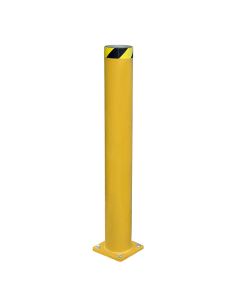
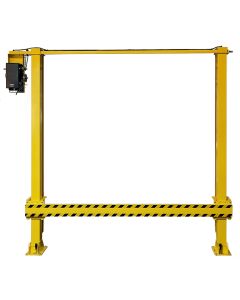
- Traffic Control: At intersections where pedestrian walkways and equipment paths cross, traffic control signs are non-negotiable per OSHA standard 1926.200. In addition to legible traffic control signs, you’ll need to protect pedestrians with appropriate traffic control devices such as Safety Bollards and Powered Dock Gates.
Signage for Forklift and Heavy Machinery Areas
The Hazard: With transportation incidents being the leading cause of fatalities in the sector, areas with forklift and other heavy machinery traffic are among the most dangerous in any warehouse. As we’ve discussed, OSHA requires legible traffic control signs under standard 1926.200 — but additional signage is necessary in most facilities to warn pedestrians of lift trucks.
The NSC reports 67 forklift-related deaths in 2023 and an average of over 12,000 serious injuries (DART cases) per year in 2021-2022. A significant number of these fatalities are due to vehicle turnovers and pedestrians being struck by the forklift.
Essential Signage:
- Traffic and Pedestrian Warnings: High-visibility "Caution: Watch for Forklift Traffic" signs should be posted at all entrances to the warehouse and at blind corners. Designating separate "Pedestrian Only" and "Forklift Traffic Only" lanes with floor tape and signs is a critical engineering control to separate people from machines.
- Operational Rules: Reinforce mandatory operator training with signs that remind drivers of key safety rules. These include signs for speed limits and blind corners, instructions to "Sound Horn at Intersections," reminders that only authorized and certified personnel may operate equipment, and rules for parking (e.g., "Lower Forks to Floor").
- Rack Load Capacity: To prevent catastrophic pallet rack collapses — a major "struck-by" hazard — every racking system must have clearly posted labels or placards that state the maximum safe load capacity per shelf and per bay.
Once again, signage is your first line of defense, not your only means of preventing forklift accidents. Safety Bollards and Powered Dock Gates can stand up to forklift strikes and provide more reliable traffic control.
Signage for Battery Charging and Storage Rooms
The Hazards: This single area concentrates three severe and distinct hazards: the emission of highly flammable hydrogen gas during the charging process, the presence of corrosive sulfuric acid in lead-acid batteries, and the risk of electrical shock and arc flash from high-voltage charging equipment.
Due to this convergence of risks, OSHA provides specific and stringent regulations for battery charging areas under standard 1926.441. Signs are also required by the National Fire Protection Association (NFPA) Uniform Fire Code, per Chapter 52.
Essential Signage: A compliant battery room must feature a system of signs that warn of all present dangers. These include:
- A "Danger" or "Caution" sign prohibiting smoking, open flames, and sparks to prevent hydrogen gas explosions.
- An "Electrical Hazard" sign to warn of high voltage and arc flash potential.
- A sign warning of "Corrosive Liquids" or "Acid."
- A sign mandating the use of "Personal Protective Equipment" (PPE), specifying items like face shields, acid-resistant gloves, and aprons.
- Directional signs clearly identifying the location of essential emergency equipment, including fire extinguishers, emergency eyewash stations, and battery acid spill kits. For additional guidance here, read: Understanding OSHA Safety Shower Requirements.
You should also have signage to establish rules that mitigate hazards (for example, “no smoking" signs).
Products to Consider: Signage and Posting Kits
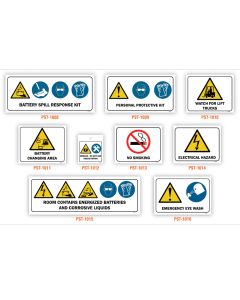
Assembling a compliant set of signs for a battery room can be a complex task. Solus Group’s Signage and Posting Kits offer a comprehensive, turnkey solution. This kit is specifically designed to meet the multifaceted requirements of a battery charging area. It includes nine signs to cover all common battery room hazards:
- Battery Spill Response Kit
- Personal Protective Kit
- Watch for Lift Trucks
- Battery Changing Area
- Broken–Do Not Use Needs Repair
- No Smoking
- Electrical Hazard
- Room Contains Energized Batteries and Corrosive Liquids
- Emergency Eye Wash
The signs are constructed from durable, easy-to-clean PVC and feature large, universal symbols to overcome language barriers.
Loading Docks
The Hazards: The loading dock is a notoriously high-risk zone. According to a report referenced in Safety and Health Magazine, an estimated 25% of all warehouse injuries occur on loading docks.
The most severe hazards include falls from unguarded dock edges and "struck-by" or "caught-between" injuries that occur when a truck unexpectedly pulls away from the dock during loading or unloading.
Essential Signage:
- Fall Protection Warnings: OSHA standard 1910.28 requires a physical guardrail system at any unprotected side or edge with a fall distance of 4 feet or more. Even with a physical barrier in place, signs warning of the "Open Dock" or "Fall Hazard" should be used as a secondary reminder to workers.
- Truck and Trailer Procedures: To prevent "trailer creep" or premature departure, signs must instruct truck drivers on mandatory procedures. These include signs stating "Chock Wheels Before Loading/Unloading" and signs indicating the location of trailer restraint systems. Clearance signs indicating the maximum height for incoming trailers can prevent structural damage and overhead collisions.
- Access Control: Loading docks are often a point of entry for non-employees. Signs that restrict access to "Authorized Personnel Only" or direct drivers to a specific check-in area can help control the flow of people in this hazardous environment.
Find Signage, Personal Protective Equipment, and Other Safety Essentials
Solus Group carries signage, PPE, traffic control barriers, and other supplies to keep your business safe and compliant. Our sales team can help you evaluate options to find everything you need to maintain a safe and efficient operation — including custom equipment built to match the unique features of your facility.
To learn more, call 314.696.0200 or send us a message online.
Related Products