We use cookies to make your experience better. To comply with the new e-Privacy directive, we need to ask for your consent to set the cookies. Learn more.
Bulk Material Handling: Integrating Bin Dumpers into Production Lines
May 19, 2026
|
Categories: Blog
According to the 2024 MHI Annual Industry Report, 55% of supply chain leaders are increasing their investments in technology and innovation to drive higher throughput and offset rising operational costs.
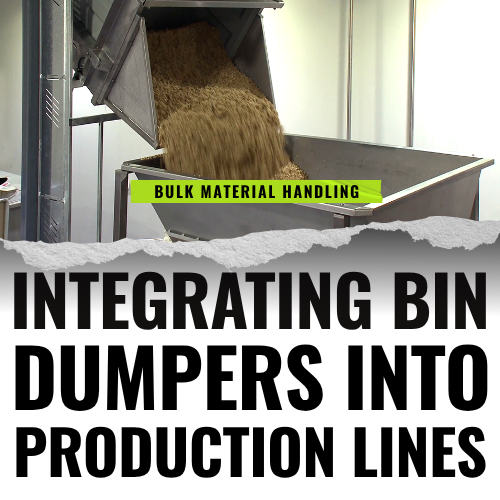
But to scale effectively, the primary challenge is straightforward: Make sure that each piece of equipment communicates perfectly with the next. The goal is to create a unified system — the transitions between machines should be seamless, and operators shouldn’t be tasked with potentially dangerous manual lifting.
A Bin Dumper can be critical material handling equipment for building this type of operation. Whether you're feeding a conveyor, a hopper, or a specialized machine, the success of your line depends on material handling equipment — and Bin Dumpers can be outfitted and customized to meet the needs of your facility.
Customizing the Interface with Cradles and Chutes
The most common bottleneck in a production line occurs when material is transferred from one machine to another. If the discharge isn't precise, you're likely to deal with product loss, safety hazards, or equipment damage.
Bin Dumpers provide that precision: They’re capable of lifting loads of virtually any weight to a given height, then tipping at an angle to empty the load. However, in high-volume production lines, the features of the Bin Dumper matter:
- Custom Cradles: While standard units handle common bin sizes, custom-engineered cradles allow you to integrate specialized containers, drums, or uniquely shaped vessels into your automated flow.
- Specialized Chutes: If you're dumping into a narrow hopper or a conveyor with limited clearance, a custom chute ensures the material flow is directed exactly where it needs to go without spilling.
- Precision Timing: Successful integration involves syncing the dump cycle with the intake capacity of the receiving equipment.
Related: What Are Bin Dumpers For? A Q&A for Every Industry
Managing Discharge Heights and Equipment Footprints
Physical integration requires working within the existing constraints of your facility. The tipping height must be high enough to clear the receiving equipment — such as a hopper or sorting table — but low enough to avoid overhead obstructions like HVAC ducts or lighting.
In addition to the tipping height, consider factors such as:
- Power Source Flexibility: Battery powerpacks allow you to move equipment between processing stations easily.
- IP Rating: Appropriate ingress protection protects internal systems from moisture and debris in harsh industrial or outdoor environments.
- Duty Cycle: High-performance units can process thousands of pounds per hour to meet continuous production demands.
- Weight Capacity: Aligning the dumper’s capacity with your specific material density ensures safe operation (and a long-term return on investment).
- Charging Requirements: Industrial float chargers keep battery-operated units ready for consistent use throughout the workday.
So, how can you find equipment that fits your application? The simplest way is to send us a message — our sales team can evaluate your use case and determine whether modifications are necessary.
In our Ridge to Reefs case study, for example, a Dumpmaster DM2400 was chosen to feed a specialized glass pulverizer. By analyzing the dimensions of the pulverizer’s intake, our sales team ensured that the glass was fed into the machine at a consistent rate without manual intervention.
That project didn’t require a high level of customization — but it required a basic analysis of the job’s needs, and our experts can provide that analysis.
Find Your Bulk Material Handling Integration Solution
Solus Group carries a range of Bin Dumpers to meet the needs of high-volume production lines, including:
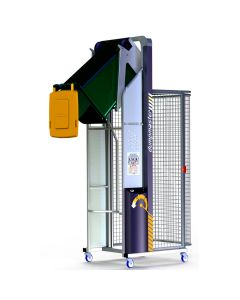
- Dumpmaster® Hydraulic Bin Dumper (DM) — The Dumpmaster is designed for applications ranging from food processing to waste management. It utilizes a unique lift-and-tip action that keeps the center of gravity within the machine’s footprint, providing stability at tipping heights up to 118 inches (3,000 millimeters).
- MegaDumper® Hydraulic Bin Dumper (MD) — Built for high-capacity industrial tasks, the MegaDumper can empty bins weighing up to 1,323 pounds (600 kilograms). Its heavy-duty construction and floor-mounted design make it a reliable choice for feeding large hoppers or industrial crushers in continuous-use environments.
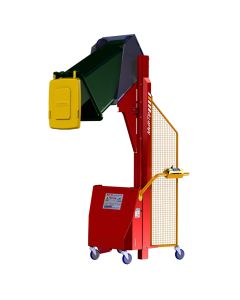
- Multi-Tip® Hydraulic Bin Dumper (MT) — For operations that prioritize speed, the Multi-Tip offers a cost-effective solution for standard 32- to 96-gallon carts. It features a fast 15-second dump cycle that helps maintain a consistent material flow in fast-paced production lines.
- Lifting Gaylord Dumper (GD) — Designed to handle Gaylords, pallet boxes, and similar large-scale bulk containers, the Lifting Gaylord Dumper features a 2,500-pound capacity and adjustable retaining bars.
All Bin Dumpers can be customized and outfitted to meet the needs of your application. If you're looking to integrate a bin dumper into your current production line, the experts at Solus Group can help you find solutions to keep your materials moving safely.
Request a quote for your material handling project or call (314) 696-0200 to learn more.
Related Products
Multi-Tip® Hydraulic Bin Dumper
For pricing, contact us by calling 314-696-0200 or Request a Quote.
In stock
Dumpmaster® Hydraulic Bin Dumper
For pricing, contact us by calling 314-696-0200 or Request a Quote.
In stock
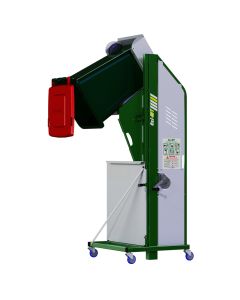
Ezi-MT® Manual Bin Dumper
For pricing, contact us by calling 314-696-0200 or Request a Quote.
In stock
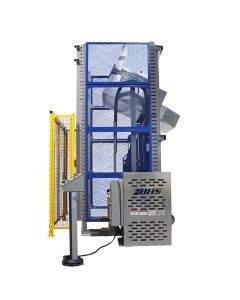
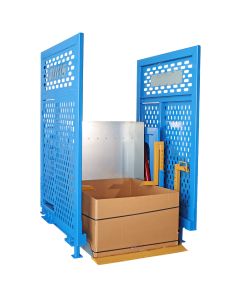
Stationary Gaylord Dumper
For pricing, contact us by calling 314-696-0200 or Request a Quote.
In stock
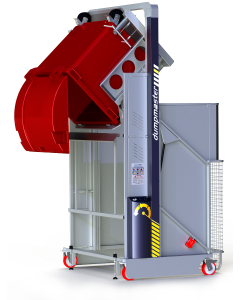
MegaDumper® Hydraulic Bin Dumper
For pricing, contact us by calling 314-696-0200 or Request a Quote.
In stock