We use cookies to make your experience better. To comply with the new e-Privacy directive, we need to ask for your consent to set the cookies. Learn more.

Improving Pallet Safety Through Ergonomics
November 3, 2026
|
Categories: Blog
Wherever you find pallets, you’ll find difficult material handling tasks — and in most cases, you’ll find people handling those tasks in less-than-ideal ways. Warehouse workers bend, twist, and lift while manually palletizing in a rush to get the work done.
But if your operation doesn’t provide people with the tools they need to handle the work ergonomically, efficiency suffers. People get musculoskeletal injuries (MSDs), which are a leading cause of worker’s compensation claims. And as every warehouse manager knows, if the job is worth doing, it’s worth doing the right way; fluid, efficient motions lead to a faster, more accurate process.
That’s where appropriate material handling equipment can make an enormous difference. Here’s what you need to know to build more ergonomic pallet processes into your workflow.
The Ergonomic Hazards of Loading and Unloading Pallets
According to OSHA, risk factors for MSDs include any combination of the following:
- Excessive exertion.
- Performing repetitive tasks.
- Working in awkward positions or the same posture for long periods of time.
- Localized pressure on a body part.
- Cold temperatures.
- Vibration of either the whole body or hand-arm.
As you might have noticed, pretty much all of those risk factors are present with palletizing with the exception of cold temperatures (unless you’re operating a cold storage facility) and vibration.
The best course of action is to perform a hazard assessment, which will involve studying the actual pallet-loading/unloading tasks at your warehouse and limiting these risk factors wherever possible. That’s important because there’s no one-size-fits-all answer here — for example, if you’re palletizing sunglasses, finding an ergonomic process is going to be quite a bit different than if you’re palletizing auto parts.
But with that said, there are some general rules to keep in mind, along with categories of material handling equipment that can help you fulfill those rules.
1. Keep pallets at an optimal working height during palletizing/depalletizing.
When handling materials manually, workers should keep the load between knee and shoulder height (the “golden zone" of ergonomics). Any higher or lower, and the risk of a musculoskeletal injury skyrockets.
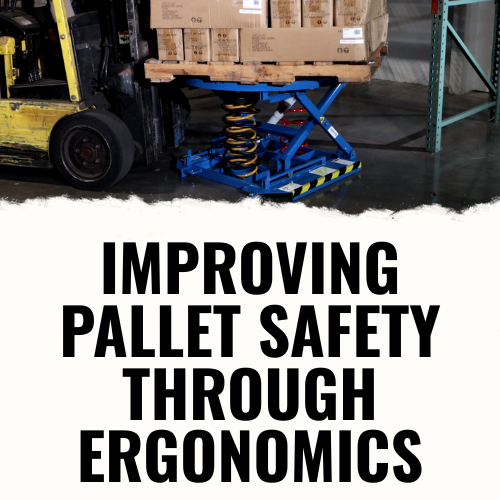
This is one area where material handling equipment can have an immediate, measurable impact. Spring-loaded pallet positioners can keep loads within the appropriate lifting zone as the total weight of the pallet changes. Units that rotate can also prevent twisting and turning — which are also key risk factors for ergonomic injuries.
If you cannot invest in pallet positioners right away, you may need to set rules for the height of pallets to prevent employees from overreaching (particularly shoulder-height and higher).
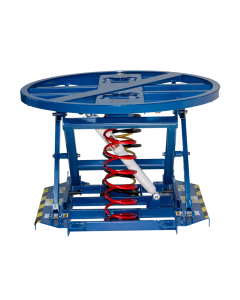
Ergonomic Material Handling Solution: BHS Self-Leveling Pallet Carousel and Skid Positioner (PCSP-S)
Designed for quick, safe pallet loading & unloading, the BHS Pallet Carousel & Skid Positioner is available in either a pneumatic airbag-actuated model or a spring-actuated model.
Both models keep pallets at a safe working height, reducing the need to bend and reach automatically. As weight is added or removed, the unit automatically positions loads between 10.5” and 27.75” (267 mm and 705 mm) without excessive bouncing or movement.
With a 4,500-lb (2041-kg) capacity, the PCSP-S can be easily transported via built-in two-way fork pockets. Custom platforms are available.
2. Keep reaching distances short and establish appropriate clearance for movements.
Bending and twisting aren’t ideal movements — so if possible, remove them from the process. Use pallet positioners with rotating tabletops so that the load moves to the worker, rather than forcing the worker to twist and turn. The PCSP-S features a turntable top, along with a small base that allows workers to stand up close to the unit.
Don’t forget about tasks related to palletizing that don’t directly involve the pallet itself. If employees handle products at workstations prior to palletizing, those workstations also need to be optimized ergonomically.
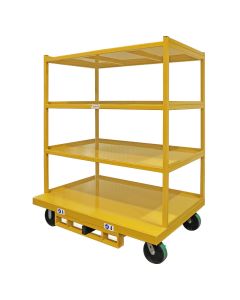
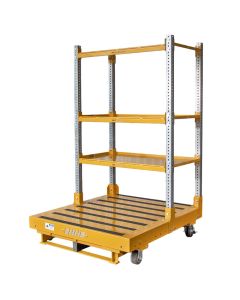
Depending on your operation, that might mean incorporating Order Picker Carts for picking merchandise or Lift Tables for keeping loads near the core of the worker’s body (the “golden zone" frequently cited in OSHA documentation).
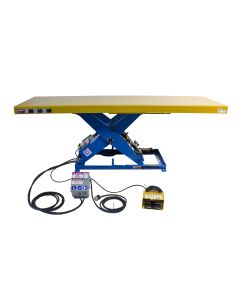
Ergonomic Material Handling Solution: BHS Scissor Lift Tables (LT Series)
Scissor Lift Tables provide an excellent solution for feeding materials to assembly lines, palletizing, and positioning all other types of heavy loads — all while keeping the work positioned ergonomically.
Load capacities range from 2,000 to 10,000 lb, with hydraulic and pneumatic options available. All BHS Scissor Lift Tables can be customized with features like ball-top and roller-top platforms, enabling seamless integration with material handling systems.
3. Where manual palletizing is necessary, rotate the assignment.
Remember that repetition is an important risk factor. If manual material handling is absolutely necessary, split the work up wherever possible — don’t assign all palletizing/depalletizing to a single group of workers simply because they’re “used to it.”
Once again, pallet positioning MHE can be really useful here. Adjustable pallet carousels and Lift Tables adjust the work to the worker, which gives managers some extra flexibility when scheduling.
Related: The Ergonomic Benefits of Variable-Height Workstations
4. Make sure work areas are clear and well-lit.
This should be obvious, but if you’re palletizing in areas where forklifts travel, you need strong controls to protect workers from vehicle strikes. Start by keeping your work areas properly lit.
You’ll also want to minimize crossing points wherever possible. Establish clear travel paths for lift trucks, using physical barriers (such as guardrails and bollards) as hard points of separation and dedicated pathways where vehicles must share travel lanes with pedestrians.
Traffic Management Solutions: Structural Barriers and Bollards
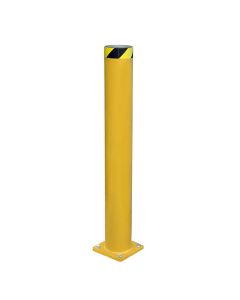
Solus Group carries a range of traffic management solutions to help you build a safer operation. Structural Bollards (SB) are made of welded steel to stop lift trucks in their tracks before they collide with valuable equipment and racking. These guard structures also have an OSHA-yellow powder-coat finish for optimal visibility.
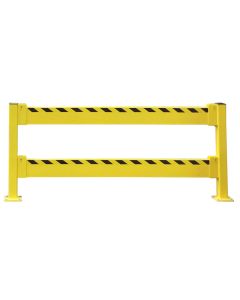
The Structural Barrier Rail (SBR) is a heavy duty guardrail system that's designed to resist the force of a forklift strike. These all-steel barriers have an impact rating of 10,000 pounds at 4 miles per hour, and are available in single-or double-rail configurations to satisfy multiple height requirements. Drop-in rails allow simple installation and create a non-permanent barrier to easily grow to match changes in your facility. Custom designs are available for more permanent installations.
Related: Choosing a Dock Safety Barrier: Rails, Gates, or Bollards?
5. Train workers and document your training.
If you don’t train workers about basic ergonomic principles, they’ll find their own ways to do the work — and those methods probably won’t be optimal from a health & safety perspective.
A basic ergonomic safety program should include:
- Principles of ergonomic lifting (such as avoiding unnecessary lifting, bending, twisting, and static postures).
- Clear explanations of what each piece of material handling equipment does and how to use it properly.
How to properly don & doff any necessary personal protective equipment. - What to do in an emergency.
It’s also advisable to retrain employees annually. Commit to additional training if and when an on-the-job injury occurs, and document all training on paper (or digitally) for compliance. Without training records, you can’t prove that training ever occurred.
Related: Creating a PPE Training Program: OSHA PPE Training Requirements
Find Pallet Material Handling Equipment with Solus Group
Whether you’re concerned about safety or looking for ways to improve throughput, the right material handling equipment can make a difference. Solus Group can help you evaluate options, including custom solutions for handling unconventional products or materials.
To speak with a member of our team, (314) 696-0200 or send us a message.
Related Products
Structural Barrier Rail
For pricing, contact us by calling 314-696-0200 or Request a Quote.
In stock