We use cookies to make your experience better. To comply with the new e-Privacy directive, we need to ask for your consent to set the cookies. Learn more.
Box Lifter Buying Guide
October 13, 2026
|
Categories: Blog
Box lifters are devices that are designed to — as the name implies — lift boxes to a certain height. Depending on the design, they may also tip and dump their loads into a larger bin, move the box onto a conveyor, or do something else to keep the box moving through a production or order-picking process.
In other words, “box lifter" is a broad category of material handling equipment. Every box lifter is engineered to improve ergonomics, which means fewer injuries and greater overall efficiency.
If you’re handling boxes, cartons, or Gaylords, box lifters play an important role in your workflow. Today, we’ll look at some of the most common categories of box handling equipment and provide some tips for purchasing.
Types of Box Lifters and Lifting Solutions
Selecting appropriate material handling equipment depends on the anticipated load weight, container dimensions, and specific workflow requirements. Below, we’ll take a look at five categories of lifters based on movement, height, and functionality.
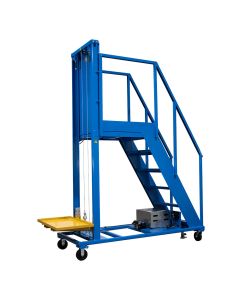
1. Lift Table Ladder (LTL)
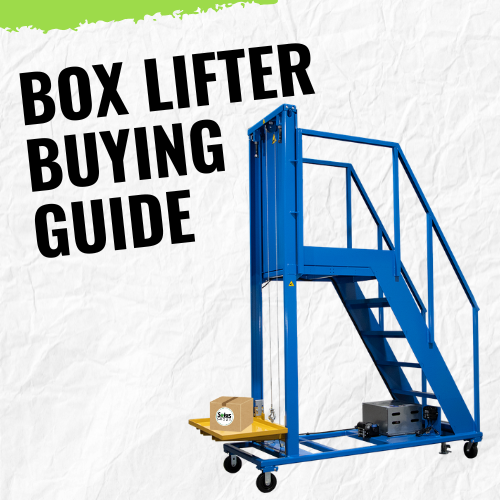
When stocking or retrieving goods from elevated shelving, operations might use standard step ladders. That creates a problem: A step ladder gets the operator to the shelf, but forces them to carry heavy boxes up and down the steps manually — creating a significant ergonomic risk.
The Lift Table Ladder solves that problem. An electric lifting mechanism moves boxes of materials up and down a heavy-duty stock ladder frame, while smooth-rolling phenolic casters allow the user to position the unit precisely down narrow stock aisles.
Key features:
- Carriage designs on the Lift Table Ladder support a robust working load limit of 450 pounds (204 kg).
- Built-in safety features include an anti-drop system, a set-down interlock, and a gravity-controlled locking latch.
Custom heights, capacities, and features are available.
When a facility requires permanent, fixed vertical transportation between entire floor levels or mezzanines, consider Vertical Reciprocating Conveyors (VRCs). While a VRC is a full-scale material lift rather than a dedicated box lifter, it has similar functionality with greater capacities.
For more info, read: What Is a Reciprocating Lift? A VRC Lift FAQ
2. Mobile Scissor Lift Tables
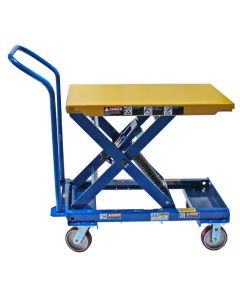
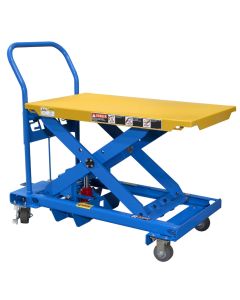
Mobile Lift Tables are a portable ergonomic solution for moving heavy boxes around a facility. They keep loads within the operator’s power zone — an important ergonomic concept — while allowing the operator to move materials both vertically and horizontally.
Options from Solus Group include:
- BHS Manual Mobile Lift Tables (MMLT) - Made with heavy-duty steel, the MMLT can support loads of up to 1,200 pounds (544 KG). Hydraulic components lift boxes and materials, while corrosion-resistant urethane casters allow for effortless travel. Integrated foot pedals allow operators to lift and lower loads; options include ball transfer and roller conveyor tabletops.
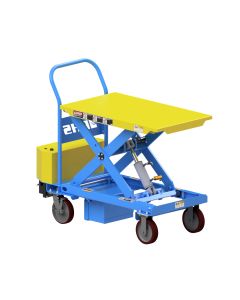
- BHS Powered Mobile Lift Tables (PMLT) - The PMLT is similar to the MMLT, but with two 12-volt deep-cycle AGM batteries to power the hydraulic lift. Designed to be low maintenance, it’s available with the same load capacities as the MMLT.
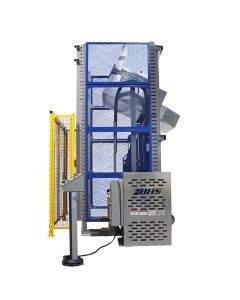
- BHS Self-Leveling Mobile Lift Tables (SMLT) - With the SMLT, the top of the load remains at a safe ergonomic height as the weight changes (for example, during unloading). It features a service capacity of 250-750 lb (113-340 kg).
3. Vacuum Lifting Devices and Light Load Cranes
Handling single boxes continuously (lifting, dropping, and repeating) requires specialized material handling equipment designed for the purpose. Packaging operations and distribution centers often use vacuum box lifters to keep products moving.
Vacuum generation systems utilize compressed air to create powerful suction. The vacuum components attach directly to lifting carton boxes, securing the load without crushing the contents. Workers simply guide the vacuum cups to the box, engage the seal, and steer the load toward its destination.
When selecting a box vacuum lift, facility managers must evaluate the surface of the payload. Tape seams or porous cardboard can disrupt the vacuum seal, so vacuum lifters might need different gripping mechanisms or pads to handle the loads.
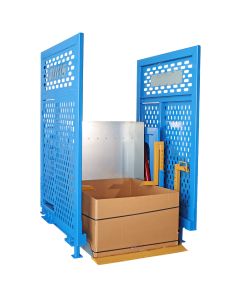
4. Stationary Gaylord Dumpers (GLD)
Gaylord boxes store bulk components, recycling, and raw materials. Emptying a Gaylord manually requires deep bending and reaching — which places some fairly extreme physical demands on workers' lower backs.
A better option is to use MHE designed for Gaylords:
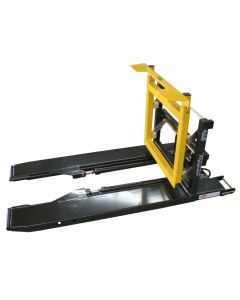
- Stationary Gaylord Dumper (GLD) - The GLD secures large containers and tilts them to precisely controlled discharge angles. Carriage widths are available in 43.5 inches (1105 mm) or 51.5 inches (1308 mm) to match your specific container requirements (including D and E Gaylords). Custom chutes can also be added to any model, allowing seamless integration into existing material flow systems. Choose between models rated for loads of 2,000 pounds or 4,000 pounds (907 or 1,814 kg).
- Mobile Gaylord Dumper (GLDM) - The GLDM is functionally identical to the standard GLD, but with smooth-rolling casters that provide total mobility. Units can be custom-built to any specifications.
5. Industrial Bin Dumpers
The Gaylord Dumper is a type of specialized Bin Dumper — but for operations handling smaller boxes, Solus Group carries a range of smaller Bin Dumpers designed for those workflows.
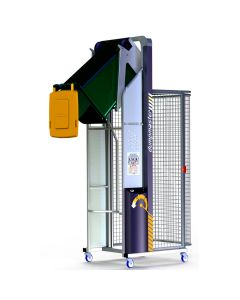
Smaller plastic crates, corrugated boxes, and metal containers require targeted tote-handling equipment for sorting or batch processing. Industrial bin dumpers raise containers and invert them over hoppers, Gaylords, or sorting tables.
Options include:
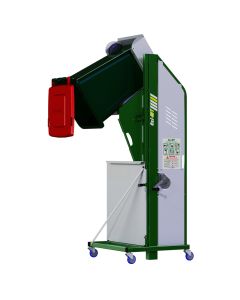
- Ezi-MT® Manual Bin Dumper (EZI-MT1500) - The Ezi-MT® Manual Bin Dumper alleviates ergonomic risks associated with dumping roll-out bins, efficiently lifting and tipping loads up to 143 pounds with a manual winch.
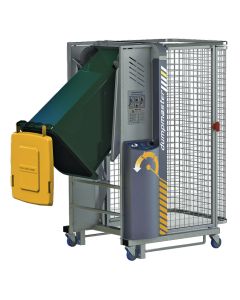
- Dockmaster® Hydraulic Bin Dumper (DM0700) - Engineered to safety tips bins, drums, and boxes from a raised dock, the Dockmaster® can be outfitted with auto-cycle operation, bin hooks, custom controls, and digital scales. Custom cradles are also available to accommodate different containers.
- MegaDumper® Hydraulic Bin Dumper (MD) - The MegaDumper® is a mobile solution for dumping large bins, handling up to 1,323 pounds (600 kg) and 290 gallons. Its heavy-duty hydraulics and electric power enable tipping heights over 33 feet, suitable for industrial use.
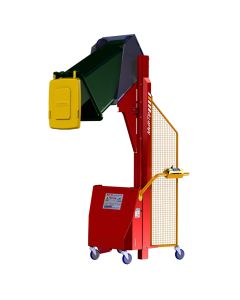
- Multi-Tip® Hydraulic Bin Dumper (MT) - With a standard cradle compatible with most 24 to 96-gallon roll-out bins, the Multi-Tip® is ideal for various settings, including offices, factories, and recycling centers. Choose from tipping heights of 47, 63, or 71 inches to match existing equipment.
- Forward Bin Tipper (FBT1000-760) - The Forward Bin Dumper converts forklifts into portable bin dumpers for cubic, pallet, and megabins. Gentle on containers, it features 135-degree rotation for complete emptying and fits standard forklift tines.
Simpro Bin Dumpers feature adjustable retaining arms that accommodate cardboard cartons, plastic crates, and steel or plastic drums without requiring manual tool changes between loads. For more info, read: Box Dumper Buyer's Guide.
Find Box Lifters to Improve Throughput
To select the correct box lifter, you’ll need to evaluate your facility’s layout, material characteristics, and daily throughput requirements.
We’re here to help. Solus Group supplies American-made material handling equipment tailored to complex logistics workflows. Contact Solus Group at 314-696-0200 or submit a request online to find box lifting solutions for your facility.
Related Products
Multi-Tip® Hydraulic Bin Dumper
For pricing, contact us by calling 314-696-0200 or Request a Quote.
In stock
Self-Leveling Mobile Lift Tables
For pricing, contact us by calling 314-696-0200 or Request a Quote.
In stock

Dockmaster Hydraulic Bin Dumper, 27.5" tip height
For pricing, contact us by calling 314-696-0200 or Request a Quote.
In stock
Ezi-MT® Manual Bin Dumper
For pricing, contact us by calling 314-696-0200 or Request a Quote.
In stock
Dumpmaster® Hydraulic Bin Dumper
For pricing, contact us by calling 314-696-0200 or Request a Quote.
In stock
Stationary Gaylord Dumper
For pricing, contact us by calling 314-696-0200 or Request a Quote.
In stock