We use cookies to make your experience better. To comply with the new e-Privacy directive, we need to ask for your consent to set the cookies. Learn more.
Safety Goggles Vs. Glasses: Which Do You Need for Industrial Safety?
April 7, 2026
|
Categories: Blog
According to the National Institute for Occupational Safety and Health (NIOSH), each day, approximately 2,000 workers in the United States sustain a job-related eye injury that requires medical treatment. Many of these incidents are preventable — and well-designed equipment can help to limit many hazards — but appropriate personal protective equipment (PPE) is a last line of defense.
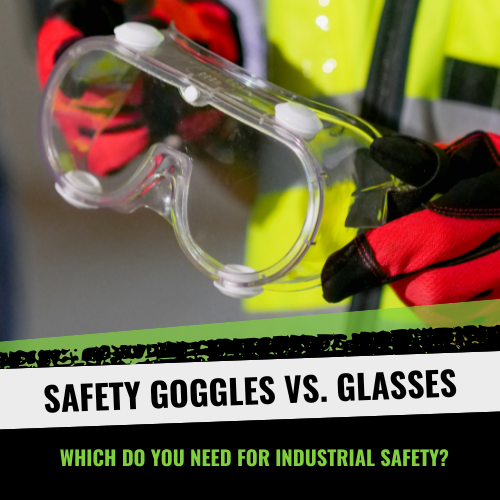
For industrial professionals working with forklift batteries, manufacturing machinery, or caustic chemicals, the choice between safety glasses and safety goggles is a matter of compliance and physical health. Here’s what you need to know to outfit your facility.
Safety Glasses in Industrial Environments
Safety glasses are the most common form of eye protection in manufacturing and assembly settings. They're designed primarily to protect against impact from flying debris, such as wood chips, metal fragments, or dust. Modern industrial safety glasses often feature anti-fog coatings and padded temples for comfort during long shifts, but they’re otherwise fairly simple devices.
But safety glasses are designed to protect against impacts, so they don't provide a 360-degree seal around the eyes. Even models with integrated side shields leave gaps between the frame and the face.
They’re unsuitable for tasks involving fine dust, heavy mists, or liquid splashes — though pairing them with a face shield can provide additional, limited protection from splashes in some settings.
Can I Use Face Shields with Safety Glasses to Improve Compliance?
The American Optometric Association (AOA) notes in its guide on protecting your vision that face shields should always be worn over primary eye protection, such as goggles, rather than as a standalone substitute. OSHA also confirms that principle in their guidance on forklift battery maintenance:
"Wear chemical splash goggles or full face shield with safety glasses equipped with side shields."
So, strictly speaking, safety goggles aren’t necessary in the battery room — but there are certain situations where goggles provide superior protection.
Related: Industrial PPE: What Must Employers Provide?
When to Switch to Safety Goggles as Primary PPE
Safety goggles prevent liquids and fine particulates from reaching the eyes. In environments where splash hazards are present, goggles are the standard.
Under OSHA 1910.133, employers must ensure that employees use eye protection that provides adequate shielding against the particular hazards of the job. For chemical handling, this usually means using Vented Chemical Splash Goggles. These goggles utilize indirect ventilation to allow for airflow while blocking the direct path of liquid droplets.
To recap, use safety goggles to protect against:
- Chemical splashes.
- Fine dust and particulates.
- Pressurized liquids.
- Acid exposure (e.g., sulfuric acid).
Use safety glasses to protect against:
- Flying debris (e.g., wood chips, metal fragments).
- High-velocity impact.
- Coarse dust.
- Direct frontal impact.
Many goggles are designed to fit over prescription eyewear, so they can also provide a simpler solution for all-day wear than prescription safety glasses. However, if you’re using safety goggles to protect against impacts, make sure they’re rated for the job. To that end, we’ll need to briefly discuss ANSI standards.
Related: Chemical PPE for the Workplace: Legal and Professional Requirements
Understanding the ANSI/ISEA Z87.1-2025 Standard
To ensure your PPE is capable of withstanding industrial rigors, look for the Z87 marking. The recently updated ANSI/ISEA Z87.1-2025 standard provides the current framework for testing and marking eye protection.
The 2025 revision focuses on clearer performance language for impact testing and minimum coverage requirements. When selecting gear, look for these specific markings:
- Z87+: Indicates the protector is rated for high-velocity impact.
- D3: Indicates the eyewear is tested for protection against liquid splashes and droplets.
- D4: Indicates protection against dust.
- X: Indicates the lenses have passed anti-fog performance testing.
Choosing a product that meets these specific ratings ensures your facility remains compliant with federal safety regulations and that your team remains protected from the specific hazards of your operation.
Related: What PPE Kit Should I Get?
Products to Consider
- Personal Protective Kit (PPE Kit): This all-in-one solution is designed specifically for battery room maintenance. The kit includes chemical splash goggles, a face shield, an acid-protection apron, haz-mat boots, and neoprene gloves to protect technicians from electrolyte splashes.
- PPE Standard Kit: A cost-effective solution for basic maintenance and spill response. It includes a disposable face shield, safety glasses, nitrile gloves, a disposable apron, and latex overboots.
- Vented Chemical Splash Goggles: These goggles feature an indirect ventilated design that prevents fogging while blocking liquid entry. The PVC body is designed to fit comfortably over most prescription eyewear.
- Safety Glasses with Side Shields: Offers lightweight polycarbonate lenses and integrated side shielding for general industrial applications where impact protection is the primary concern.
Choosing the right eye protection is vital for a safe facility. Solus Group offers a full range of PPE designed for demanding industrial environments. Contact us at 314-696-0200 or browse our selection to find the right equipment for your team today.