We use cookies to make your experience better. To comply with the new e-Privacy directive, we need to ask for your consent to set the cookies. Learn more.
Ergonomic Lifting Equipment in Workplace Safety Programs
February 17, 2026
|
Categories: Blog
Your workplace safety program isn’t just about compliance; it’s about running the most efficient facility possible. Safe workplaces retain more employees, achieve higher throughput, and see fewer workers' compensation claims — they’re simply better places to work.
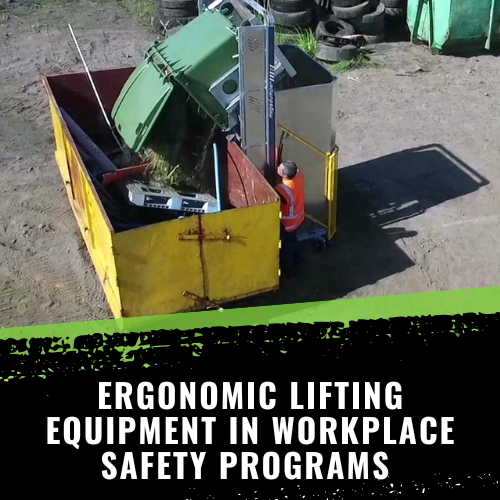
But to build a safer workplace, you need material handling equipment (MHE) designed for the task at hand. Without ergonomic lifting equipment, even the most well-documented safety plan can fail to address the leading cause of worker injuries: musculoskeletal disorders caused by overexertion.
Investing in ergonomic lifting equipment is the most effective way to transform a passive safety policy into a proactive risk-management strategy. In this article, we’ll outline the essential components of a modern workplace safety program.
To find ergonomic equipment that fits seamlessly into your organization’s workflow, call us at 314-696-0200 or send us a message.
Key Components of a Modern Workplace Safety Program
A successful workplace safety program requires proactive risk management — not just warning signs and policy handbooks (though those are important, too). Safety must be integrated into every level of the facility's culture and daily workflow.
The primary goal is to provide a workplace free from recognized hazards, as mandated by the Occupational Safety and Health Administration’s (OSHA) General Duty Clause. To that end, you’ll need to establish a cycle of hazard assessment, employee training, and the implementation of engineering controls.
In the context of material handling, this means looking beyond basic compliance and focusing on how equipment can be used to prevent injuries before they occur.
Workplace safety programs are most effective when these five statements are true:
- Management makes a commitment. Leadership must prioritize safety as a core business value and invest in high-quality MHE.
- Workers participate in planning. Employees who perform the tasks daily are often the best at identifying "near-misses" and ergonomic
- Hazards are assessed regularly. Regular zone audits are performed to pinpoint issues (such as material handling tasks that could be automated).
- Hazard prevention is prioritized. Engineering controls take precedence over administrative fixes.
- Safety training is ongoing. Managers ensure that every operator is certified and understands how to use specialized lifting tools safely.
Engineering controls are vital, because some hazards cannot be eliminated entirely. The goal of an engineering control is to prevent the worker from coming into contact with the hazard — in this case, the repetitive manual lifts that cause injuries.
Ergonomic Lifting Equipment Addresses A Major Hazard
According to the Liberty Mutual Workplace Safety Index, ergonomic hazards are the leading cause of worker injuries; overexertion alone costs about $12.53 billion per year. When a workplace safety program fails to provide ergonomic lifting equipment, it forces workers to rely on manual force, which leads to burnout and high turnover rates.
Ergonomics focuses on designing the job to fit the worker, rather than forcing the worker to adapt to an inefficient process. By reducing the physical effort required to move heavy loads, businesses can significantly lower their risk of back and shoulder injuries.
Manual handling is inherently unpredictable. Even a highly trained worker can suffer a debilitating injury if a load shifts or if they are fatigued. Specialized ergonomic material lifting equipment (MHE) removes the human element from the most dangerous parts of the lift.
To that end, look for products with these types of features:
Feature #1: Load Positioning and Height Adjustment
The most effective ergonomic lifting equipment allows workers to maintain a neutral posture while handling materials. Forcing a worker to repeatedly bend, reach, or twist while carrying weight is a high-risk task.
When planning work areas, look for lifting solutions like Scissor Lift Tables. Bringing the work to the operator's level eliminates the need for awkward postures and dramatically reduces the risk of work-related musculoskeletal disorders.
Feature #2: Stable, High-Capacity Frames
Durability is a safety feature. Equipment used in manufacturing, warehousing, and construction must be built from heavy-duty, welded steel to handle the rigors of modern worksites. A robust frame also protects high-value assets from damage during transport, further improving the ROI of the equipment.
Feature #3: Mobile Maneuverability
Safety is compromised when heavy equipment is difficult to move. Poor maneuverability leads to haphazard placement, which can result in trip hazards from long cord runs or obstructed emergency pathways.
High-quality ergonomic lifting equipment should be easy to transport throughout a facility, and should promote appropriate ergonomic practices during transport. Look for products with a combination of fixed and swiveling casters, as well as handles for manual movement and fork pockets for transporting loads via lift truck.
The Business Case for Ergonomic MHE
The primary objective of any safety program is the protection of personnel. With that said, ergonomic MHE will also provide a return on investment — and fairly quickly.
Ergonomic equipment provides:
- Substantial Direct Cost Savings: As we mentioned earlier, overexertion involving outside sources remains the leading cause of disabling workplace injuries, costing U.S. businesses approximately $12.53 billion annually in direct costs.
- High Return on Investment: Data from the Occupational Safety and Health Administration (OSHA) and the American Society of Safety Professionals (ASSP) indicates that for every $1 invested in effective safety and health programs, businesses can see a return of $4 to $6 in reduced costs.
- Drastic Reduction in Claims: A landmark study published in the American Journal of Industrial Medicine found that insurer-supported engineering controls and ergonomic interventions reduced workers' compensation claim frequency by 66% and cost per employee by 81%.
- Enhanced Operational Throughput: Implementing specialized positioning equipment can increase material handling productivity by 25% to 40% on average, as it allows operators to maintain a consistent pace without the fatigue-induced slowdowns common in manual operations.
- Rapid Results: For most facilities, the investment in ergonomic lifting equipment pays for itself in less than one year, with median payback periods occurring in as little as five months due to decreased absenteeism and higher throughput.
Products to Consider: Ergonomic Solutions for Warehouses
To transition from policy to practice, your facility requires equipment that physically eliminates manual lifting hazards. Solus Group offers several specialized solutions designed to fit into modern, safety-conscious workflows.
We’re also ready to help you find custom solutions that fit with your workflow. Whether you're working with heavier, awkward materials or designing a custom assembly line, Solus Group can help you analyze your workflow and create MHE that works. Send us a message to learn more about custom MHE.
Scissor Lift Tables (LT)
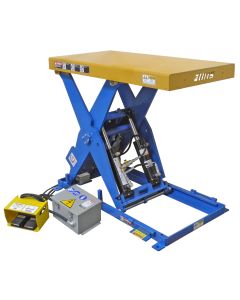
Scissor Lift Tables are the fundamental engineering control for vertical material movement. These units allow operators to adjust the height of a load to their specific power zone (the area between the mid-thigh and mid-shoulder height).
By keeping the work at an optimal height, these tables eliminate the need for repetitive bending and reaching, which are the primary triggers for lower back strain.
Upender (UPD)
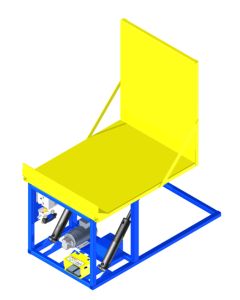
The Upender (UPD) is a heavy-duty positioning tool designed to rotate large, awkward loads—such as steel coils, paper rolls, or heavy machinery—through a 90-degree arc. By mechanizing the process of turning a load from a vertical to a horizontal orientation, the UPD eliminates the need for high-risk manual rigging or the use of multiple pieces of equipment.
Pallet Carousel & Skid Positioners (PCSP)
Designed for high-volume palletizing, the Spring Loaded Skid Positioner (PCSP-S) and Pneumatic Skid Positioner (PCSP-P) use a self-leveling mechanism to automatically adjust the height of the pallet as weight is added or removed. The operator doesn’t need to manually reposition the load, which improves both ergonomics and throughput.
Bin Dumpers
Manual bin tipping is one of the most hazardous tasks in a warehouse. Solus Group offers a comprehensive line of bin dumpers to automate the lifting and tipping of waste or raw materials.
- Multi-Tip (MT): This lightweight, hydraulic unit is designed for frequent emptying of bins up to 330 lb (150 kg). Its lift-and-tip action keeps weight within the footprint for maximum stability.
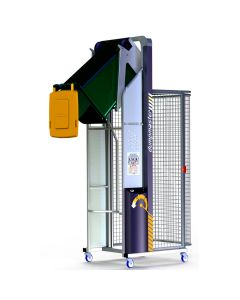
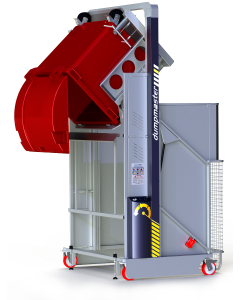
- Dumpmaster (DM): As the flagship heavy-duty hydraulic dumper, the Dumpmaster handles bins and drums up to 660 lb (300 kg). It offers various tipping heights up to 106 inches to suit industrial waste streams.
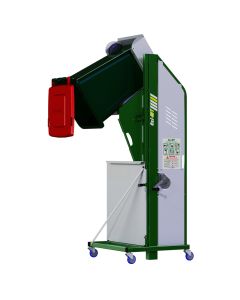
- Ezi-MT (EZI-MT): This manual, winch-operated dumper is ideal for low-volume applications and lighter loads. It provides an economical way to remove the physical strain of manual tipping in small spaces.
- Dockmaster (DM0700): Specifically designed for loading docks, this model safely empties bins from a raised platform into ground-level dumpsters. It features safety bars and feet to prevent the unit from rolling over dock edges.
- MegaDumper (MD): The MegaDumper handles capacities starting at 1,320 lb and ranging up to 1,650 lb. It’s the preferred solution for high-volume manufacturing and heavy industrial waste management.
- Bin Blaster (BB1000): The Bin Blaster is a specialized system that lifts and tilts wheelie bins to an ergonomic height for manual washdown. It facilitates efficient cleaning while preventing the awkward postures associated with ground-level bin scrubbing.
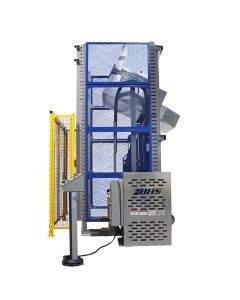
- Lifting Gaylord Dumper (GLDL): This stationary installation elevates and tilts large Gaylords and bulk containers for controlled dumping. It features a configurable travel height and heavy-duty capacity for demanding industrial environments.
BHS Panel Carts (PC)
Transporting large, flat items like sheet metal or drywall is notoriously difficult to perform safely by hand. BHS Panel Carts are engineered to hold these materials vertically at a slight angle.
The PC features an elevated 11.5-inch deck, which ensures the load remains within the operator’s power zone during loading and unloading. By keeping materials off the floor and allowing workers to push the load using their leg muscles rather than carrying the weight on their upper body, the PC provides a stable, ergonomic solution for both transportation and storage.
Optimize Your Workflow with Solus Group
Effective material handling requires equipment that works as hard as your team does. Whether you’re retrofitting an existing warehouse or designing a new fulfillment center, Solus Group provides the ergonomic tools necessary to protect your workers and your profits.
To learn more about our ergonomic lifting solutions or to receive a quote for your facility, call the Solus Group team at 314-696-0200 or contact us online to get started today.
Related Products
Dumpmaster® Hydraulic Bin Dumper
For pricing, contact us by calling 314-696-0200 or Request a Quote.
In stock
Ezi-MT® Manual Bin Dumper
For pricing, contact us by calling 314-696-0200 or Request a Quote.
In stock
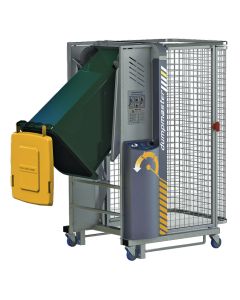
Dockmaster Hydraulic Bin Dumper, 27.5" tip height
For pricing, contact us by calling 314-696-0200 or Request a Quote.
In stock

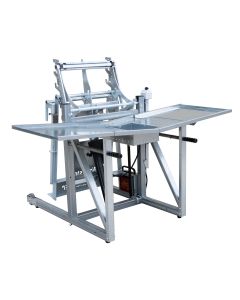
MegaDumper® Hydraulic Bin Dumper
For pricing, contact us by calling 314-696-0200 or Request a Quote.
In stock